The $100K/Year Side Business Blueprint: Patterns from 100 Founder Stories
One founder hit $100K/year selling Excel templates. Another did it with a niche newsletter in 14 months. Across 143 founder interviews from Starter Story, My First Million, and Greg Isenberg, the same patterns kept surfacing -- specific business models that consistently cross $100K, the revenue milestones that separate real businesses from abandoned side projects, and the exact sequence most successful founders follow.

In this guide:
What Is the $100K Side Business Opportunity in 2025?
The $100K side business opportunity in 2025 stems from AI tools compressing build times from months to days, combined with a $582 billion gig economy where 27% of Americans now have side hustles. But here's what the data doesn't tell you: most side hustlers earn around $885/month.
The founders we analyzed broke through that ceiling. We studied 143 videos across three channels - Starter Story (founder interviews with revenue numbers), My First Million (business ideas and trends), and Greg Isenberg (startup ideas and validation) - to find the patterns that separate $10K businesses from $100K+ businesses.
The AI acceleration factor
AI-powered building was mentioned in 74 of 143 videos - more than any other strategy. Founders are using Cursor, Claude, and ChatGPT to build products in days that would have taken months. One founder built a $15K/month AI app "in a day."
The opportunity is real, but the path matters. If you want the full playbook on running a one-person business, our solopreneur playbook covers the systems, mindset, and revenue models from 115 founder interviews. Let's look at what actually works.
Which Business Models Work Best for Solo Founders?
The business models that work best for solo founders are AI tools and automation (59 mentions), SaaS/Micro-SaaS (43 mentions), content/creator businesses (15 mentions), marketplaces and directories (15 mentions), and productized services (14 mentions). Based on 143 founder interviews, these are the models solo founders are using to reach $100K+ in annual revenue.
AI Tools & Automation (59 mentions)
The most-discussed business model. Founders are building AI wrappers, automation tools, and AI-powered SaaS products. The barrier to entry has dropped dramatically with tools like Cursor and Claude.
Example: One founder built two AI apps generating $15K/month while working only 4 hours per day.
SaaS / Micro-SaaS (43 mentions)
Small, focused software products solving specific problems. The key pattern: clone and improve existing successful products rather than inventing something new.
Example: "I cloned 3 apps and now make $35K/month" - Samuel taught himself to code and built on proven ideas.
Content / Creator Businesses (15 mentions)
YouTube channels, newsletters, and content-driven businesses. The niche matters more than the size. One founder makes $125K/year as a "niche YouTuber."
Key insight: One piece of content can drive an entire business. One founder built a $30K/month app from a single viral piece of content.
Marketplaces & Directories (15 mentions)
Job boards, directories, and listing sites. These can be built quickly and monetize through listings, ads, or premium features.
Example: A job board built in a weekend now makes $1M/year. The founder is a solopreneur who built it in 30 hours.
Productized Services (14 mentions)
Taking a service and packaging it as a fixed-price product. This model allows for predictable revenue while maintaining margins.
Example: Scott built a $600K one-person business doing video editing for B2B SaaS companies - a productized service with fixed pricing.
Mobile Apps (13 mentions)
iOS and Android apps, particularly in health, productivity, and utility categories. The app stores provide built-in distribution.
Example: A habit tracking app generates $15K/month. A mental health app achieved $1M+ in revenue and 4 million downloads.
How Do You Get Your First Revenue as a Side Business?
You get your first revenue as a side business by validating demand before building, launching on Reddit or community platforms, finding a paying user early, and cloning successful products with improvements. The first dollar is the hardest, but here's how the founders in our dataset got their first customers and validated their ideas.
Validate Before Building
The most successful founders validated demand before writing code. Justin Mares (Kettle and Fire) used landing pages and early ad spend to test demand before building - the same method that built a $100M brand.
Reddit and Community Launch
Excel Formula Bot went viral after being posted on Reddit, leading to "the first sale within minutes of launch." Reddit, Hacker News, and Product Hunt were the top launch channels mentioned.
Find Your First Paying User Early
Leandro, who built a $9K/month micro-SaaS, advises: "Find your first paying user early on to validate your idea's value." Don't wait for a perfect product.
Clone and Improve
Samuel's strategy: "Identify successful apps, clone them, and improve." This approach "validates the market and reduces the risk of failure." He now makes $35K/month from 3 cloned apps.
The 30 failures pattern
Multiple founders mentioned failing 20-30 times before finding success. One built a $10K/month app "after failing 30 projects." Persistence and rapid iteration matter more than the first idea. For frameworks on getting those first customers faster, see our early user acquisition guide.
Key Takeaway
The most reliable path to first revenue is not building something new -- it is cloning a product that already works and improving it. Multiple founders in the dataset hit $10K-$35K/month this way. It removes the biggest risk (validating demand) and lets you focus entirely on execution and differentiation.
Find More Business Playbooks
Explore data-driven guides on AI automation agencies, customer acquisition, and growth strategies -- all built from real founder interviews.
How Do You Scale from $10K to $100K?
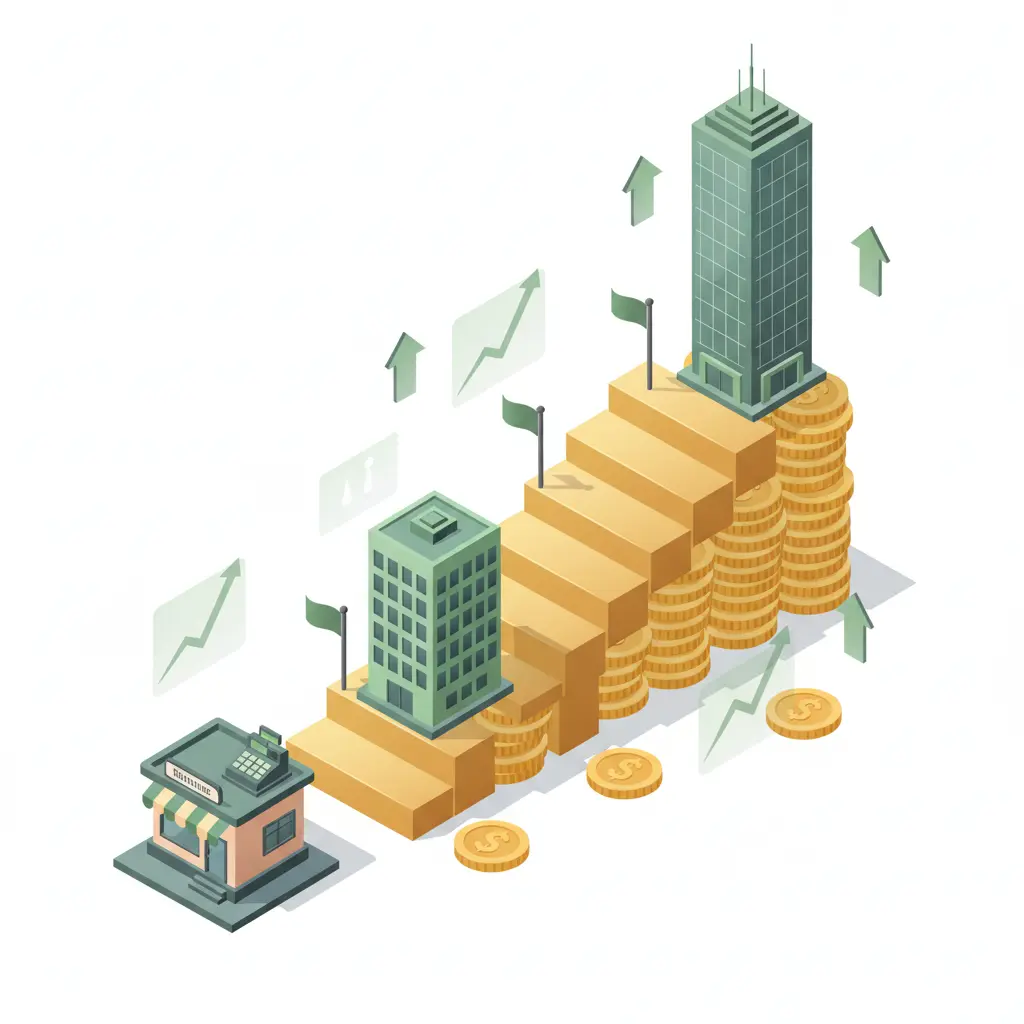
You scale from $10K to $100K by shifting from hustle to systems: strategic repositioning, prioritizing distribution over product, and replacing personal effort with repeatable processes. Getting to $10K is one challenge. Getting to $100K requires different skills. Here's what we learned from founders who made that jump.
| Revenue Range | Videos | Example Businesses |
|---|---|---|
| $10K-$25K/mo | 19 videos | Excel Formula Bot, AI apps, micro-SaaS |
| $25K-$100K/mo | 15 videos | Cloned apps, Reddit-built businesses |
| $100K+/mo or $1M+ total | 31 videos | Job boards, open-source SaaS, mobile apps |
What Changes at $100K
Positioning becomes critical
Sean took his app from $0 to $4M ARR with one strategic repositioning move
Distribution matters more than product
"Prioritize distribution from day one" - founders who built $30K/month apps
Systems replace hustle
My First Million: "The more valuable you are, the less valuable the company is"
Common $100K+ Patterns
Open source as a moat
Papermark: $900K/year bootstrapped open-source SaaS
Niche domination
$600K one-person business focused only on B2B SaaS video editing
Simplicity wins
"The key to Letterly's success lies in its relentless focus on simplicity"
Our take
The most striking pattern across all 143 interviews is not the business model or the strategy -- it is the ratio of AI tools to everything else. AI-powered building was mentioned 74 times, more than double any other strategy. But here is what that really means: the founders who are winning in 2025 are not the best coders or the best marketers. They are the ones who figured out how to use AI to compress the build-test-iterate cycle from months to days. The business model almost does not matter if you can ship and validate fast enough. That said, AI tools alone will not get you to $100K. Distribution still matters. The founders who combined AI-speed building with Reddit marketing and niche focus were the ones who actually crossed the $100K line.
How Much Time Does a Side Business Actually Require?
A side business can require as little as 4 hours per day once established, and AI tools have compressed initial build times from months to days or even hours. The answers varied wildly across founders, but some patterns emerged.
The pattern is clear: AI tools have compressed the building timeline dramatically. What took months now takes days or even hours. But building is only part of the equation - customer acquisition and iteration still take time.
Sebastian, who built a $15K/month habit tracking app, focused on "a clean, simple interface and core habit tracking functionality for the MVP, prioritizing user privacy with local data storage." The MVP-first approach lets you start earning while improving.
The app-a-month challenge
Adam, who went from $200K in debt to building a $1M app, "embarked on a challenge to create one app per month to learn and validate ideas quickly." Rapid experimentation beats perfectionism. Our idea validation playbook shows how to compress that validation cycle to 2-4 weeks.
What Strategies Actually Work for Side Business Growth?
The strategies that actually work for side business growth are AI-powered building (74 mentions), Reddit and community marketing (29 mentions), niching down (29 mentions), cloning and improving existing products (28 mentions), and building in public (21 mentions). We counted how often each strategy was mentioned across 143 founder interviews and ranked them by frequency.
AI-Powered Building
Using Cursor, Claude, ChatGPT to accelerate development. The most mentioned strategy by far. Founders are building MVPs in hours, not months.
Reddit & Community Marketing
Launching on Reddit, Hacker News, and niche communities. Free distribution with engaged audiences. The Excel Formula Bot's first sale came "within minutes" of a Reddit post.
Niche Down
Focusing on specific markets rather than going broad. The $600K video editing business only serves B2B SaaS companies. The $125K/year YouTuber focuses on a specific niche.
Clone & Improve
Finding successful products and making better versions. "I copied a $100M SaaS, undercut their prices, and made $10K" - the strategy "validates the market and reduces risk."
Build in Public
Sharing your journey transparently. Builds audience, accountability, and provides free marketing. Many founders credit this for their initial traction.
Strategy advice from $41K/month founder
"Improve existing ideas, find niches, use AI for rapid MVP development, and get to market quickly." Joe's advice captures the essence of what works in 2025.
Want to research side business ideas?
Taffy lets you analyze transcripts and comments from any YouTube channel. Find out what business ideas viewers are asking about, what problems they need solved, and what niches are underserved.
Get Started FreeFree daily channel insights. No credit card required.
Frequently Asked Questions
What business models work best for solo founders?
Based on 143 founder interviews, the top models are: AI tools and automation (59 mentions), SaaS/Micro-SaaS (43), content/creator businesses (15), marketplaces and directories (15), and productized services (14).
How long does it take to build a $100K side business?
Timelines vary widely. Some founders built $1M/year businesses in a weekend, while others took years. The key pattern is rapid validation and launching quickly. With AI tools, many founders now build MVPs in days.
What are the best strategies for getting first customers?
The most mentioned strategies are: Reddit and community marketing (29 mentions), building in public (21 mentions), and cloning/improving existing successful products (28 mentions).
How much time investment is required?
Time investment varies. Some founders report working only 4 hours per day with AI tools. Others built products in weekends. The key is leveraging AI tools to accelerate development and reduce time to launch.
Should I build something new or copy an existing product?
Many successful founders recommend copying and improving existing products. As one founder put it: the approach "validates the market and reduces the risk of failure." Find something that works and make it better.
Written by
Arun Agrahri
Builder of Taffy. I spend most of my time analyzing YouTube channels to find patterns others miss. These guides are the result of processing thousands of videos and comments through our data pipeline.
Get the next guide first
We publish deep-dive research guides weekly. Be the first to know when new analysis drops.
No spam. Unsubscribe anytime.