How to Get Your First Customers: 14 Strategies That Actually Work
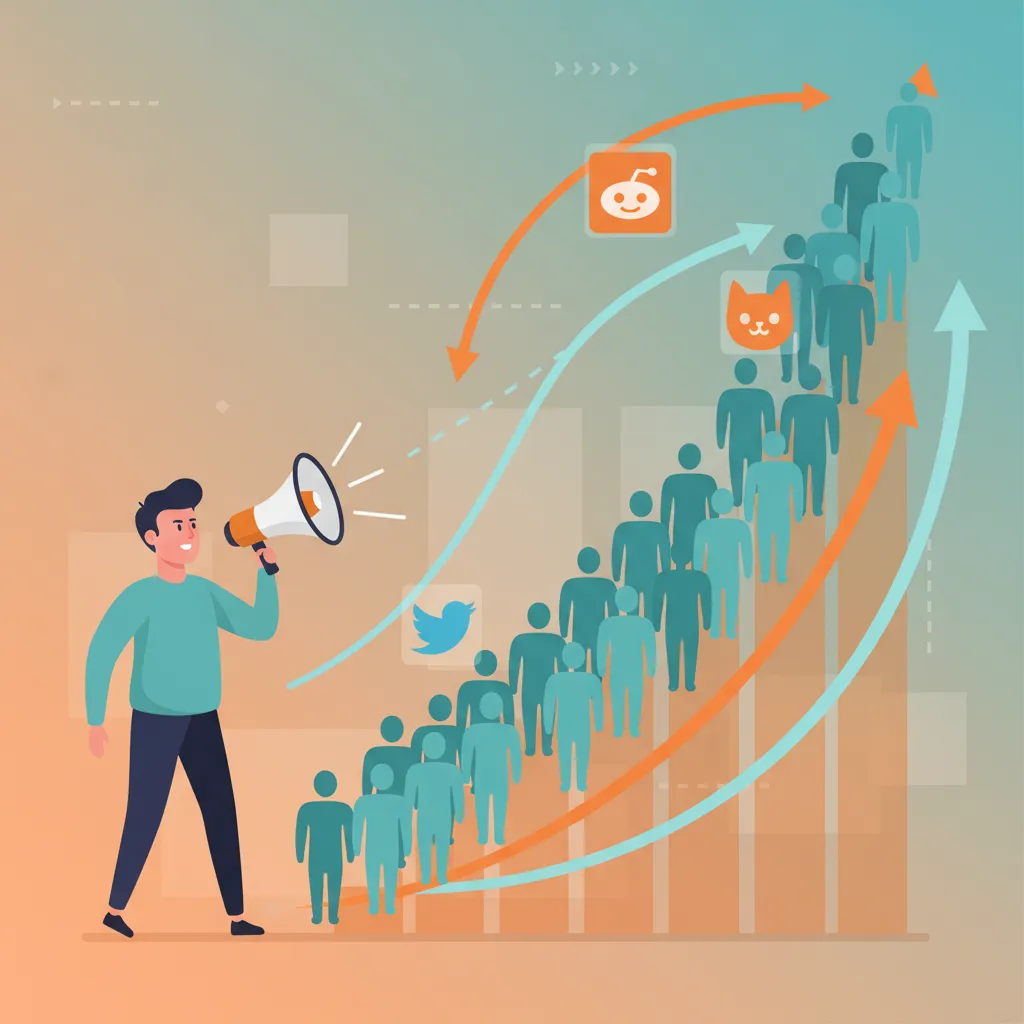
One founder got her first 500 signups from a single Reddit post she almost didn't publish. Another cold-DMed 200 people on Twitter and converted 40 into paying users within a week. Across 50 interviews on Starter Story, the early user acquisition playbooks were scrappy, specific, and nothing like the advice in growth marketing blogs.
Jump to a strategy:
Last month, I sat down and watched every Starter Story interview from the past year. Fifty founders. Everything from $10K/month solo apps to $10M/year SaaS companies.
What surprised me: the same strategies kept coming up. Not vague advice like "build a great product" but specific tactics. Post on this subreddit. Structure your tweet like this. Launch here first.
I pulled out every acquisition strategy mentioned, grouped them by frequency, and ranked them by results. The founders generating $50K+/month almost always combined 2-3 of these approaches.
Here's what actually works to find your first customers.
How Does Reddit Marketing Work for Getting First Customers?
"I used Reddit to hit $17K MRR with zero audience." — Diego, App Alchemi
Reddit marketing works by creating genuinely useful posts in relevant subreddits where your product gets mentioned naturally, not pitched aggressively. This came up more than any other strategy in our research. Diego grew App Alchemi to $17K MRR entirely through Reddit. Pat Walls built Starter Story's initial audience the same way. Ben got 2 million organic visitors to Tech Lockdown through Reddit-style content marketing.
The approach that works isn't what you'd expect. You can't just drop links — moderators will remove them instantly. Instead, these founders created genuinely useful posts where the product gets mentioned naturally at the end.
The Reddit Playbook (4 Steps)
- Warm up your account first. Spend 2-3 weeks being a genuine community member. Comment on posts. Be helpful. Build karma.
- Find your subreddits. Diego recommends using Reddit's ad targeting tools to discover communities where your users hang out. Look for subreddits with 10K-500K members — big enough for traffic, small enough that your post won't get buried.
- Write value-first posts. Share a how-to guide, a framework, or useful information. Mention your product in one line at the end: "I built a tool that does this if anyone's interested."
- Post consistently. Not once — multiple times across different subreddits. Pat Walls says one viral Reddit post changed his business trajectory.
Ben from Tech Lockdown had a specific tactic: he wrote a comprehensive guide on "how to turn an iPhone into a dumb phone" and posted it to relevant subreddits. That single piece of content drove the majority of his early traffic.
What Pat Walls learned the hard way:
"Instead of direct link posts, create valuable content directly on Reddit, embedding a small link at the end. This bypasses the rules and leads to significant engagement."
One crucial step: convert Reddit traffic to an email list immediately. Reddit traffic is temporary. Pat nearly got banned, but by then he'd already built a substantial email list that couldn't be taken away.
Key Takeaway
Reddit outperformed every other acquisition channel in the founder data -- but only when done right. The founders who failed on Reddit dropped links. The ones who succeeded spent weeks building karma before ever mentioning their product, then wrote value-first posts with their product as a footnote. Diego grew to $17K MRR entirely through Reddit with this approach.
Can Building in Public on Twitter/X Drive Early Sales?
"I hit $1M ARR in 117 days from a single tweet to my 16 followers." — Yaser, Chatbase
Yes, building in public on Twitter/X can drive substantial early sales, even with a tiny following. Yaser started with 16 Twitter followers. His first tweet about Chatbase went viral, and the company hit $1 million ARR in 117 days. Alex Finn made $100K in ARR within 15 minutes of launching Creator Buddy to his Twitter audience. CJ grew CodeGuide to $42K/month using what he calls "tutorial marketing."
Building in public isn't just about posting progress updates. The founders who succeed treat every feature release as a mini-launch.
What Makes a Tweet Go Viral
Yaser broke down the elements of his viral tweet:
- A familiar interface (his looked like ChatGPT, which people recognized)
- Minimize time to the "aha moment" — show what it does immediately
- Mention the tools used to build it (developers love seeing the stack)
Tutorial Marketing
CJ from CodeGuide has a specific framework. He creates threads and long-form posts that explain a problem, walk through the solution, and position his SaaS as part of that solution. It's teaching first, selling second.
All his traffic comes from Twitter/X. No paid ads. He built an audience by being genuinely helpful, and that audience converted when he launched.
The distribution advantage:
"Distribution, not just product, is the new moat. If you have an audience, you can launch anything and get immediate feedback and sales." — Alex Finn
If you don't have an audience yet, start by providing value. Reply to relevant threads. Share insights from what you're building. Document the journey. It compounds faster than you'd expect.
How Do Marketplaces Give You Built-In Customers?
"My apps make $4.5M/year with $0 marketing." — Ericos, Shopify Apps
Marketplaces give you built-in customers because people are already searching for solutions on these platforms, so you don't need to find them. Ericos built Shopify apps that generate $4.5 million annually without spending a dollar on marketing. Lucas makes $25K/month from a countdown timer app on Monday.com's marketplace. S. grew his Chrome extension to $20K/month by building for ChatGPT users.
The insight: marketplaces have built-in demand. People are already searching for solutions. You don't need to find them — they find you.
Best Marketplaces for Early Customers
- Shopify App Store — Massive merchant base, high willingness to pay
- Monday.com Marketplace — Underexplored, high-paying enterprise customers
- Chrome Web Store — Lower competition for utility extensions
- Notion Integrations — Large community of power users
- Google Workspace Marketplace — Leandro built Synto Sheets here, now $9K/month
The Strategy
Ericos looks for three things: ease of building, broad market appeal, and low competition. He validates by engaging with online communities and gauging interest before writing code.
S. (Chrome extension builder) has a different take. He targets large platforms like Gmail or Twitter where extensions add clear value, or smaller platforms with dedicated marketplaces where competition is lower.
Why this works:
"Marketplaces offer a less crowded environment and easier product validation compared to standalone platforms. The customer base is already there." — Demitro, Screenshot One
The catch: you're dependent on the platform. If they change policies or build competing features, you're exposed. But for getting early customers quickly, it's one of the fastest paths.
Not Sure If Your Idea Has Demand?
Our Idea Validation Playbook shows how 49 founders validated demand before writing code -- including pre-sale frameworks and kill signals.
Can Short-Form Video on TikTok Drive Real Revenue?
"A $100 investment in two creators led to $80K profit on day one." — Blake Anderson, Riz GPT
Short-form video on TikTok can absolutely drive real revenue, sometimes generating massive returns from minimal investment. Blake Anderson built three apps generating $10M combined. His first, Riz GPT, made $80K in profit on launch day from just $100 spent on two "underground" TikTok creators.
Jack Ficks makes $10K/month by spending one hour daily creating organic content on TikTok and Instagram. Uray drives $300K/year in revenue from a car sound device through faceless short-form videos.
The Content Formula
Jack Ficks has a repeatable template that works:
- Hook in the first second
- Show the problem
- Demonstrate the solution
- Brief call to action (95% entertainment, 5% sell)
- Post daily, one hour of work
Steven, who makes $40K/month from a mobile app, puts it bluntly: "Marketing is 95% of app success." He analyzes viral content in his niche, creates entertainment-first videos, then repurposes successful organic posts into paid ads.
On finding creators:
"Start with small creators. Better ROI and they're more responsive. Focus on their audience's conversion potential, not follower count." — David Park, Jenny AI
The advantage of short-form video: you can reach millions of people without spending on ads. A phone is all you need. The challenge: it requires consistency and willingness to experiment with formats until something hits.
Is Product Hunt Still Worth It for Early Traction?
Product Hunt is still worth it for early traction, especially for developer tools, productivity apps, and SaaS products targeting early adopters. It came up repeatedly in our research as an early traction driver. Fernando launched AI Carousels through a 10-day "build in public" challenge and used Product Hunt to get initial users. Demitro lists it as one of his key channels alongside Twitter and Google.
The platform works best for developer tools, productivity apps, and SaaS products. The audience is specifically early adopters willing to try new things.
Making It Work
- Prepare assets in advance (video demo, screenshots, compelling description)
- Launch at 12:01 AM PT for maximum exposure
- Engage all day — respond to every comment
- Mobilize your network early (first few hours matter most)
- Use the Product Hunt badge on your site afterward for social proof
Product Hunt isn't a magic bullet — many launches fizzle. But for products that fit the audience, it provides a concentrated burst of early adopters who give feedback and spread the word.
How Do You Use SEO and Content Marketing for Early Growth?
"I learned SEO, created landing pages for various search terms, and grew from $0 to $6M revenue." — Saba, V.io
You use SEO and content marketing for early growth by creating landing pages, blog posts, and videos targeting every search term your potential customers might use. Saba built V.io (a video editing platform) to $200M by obsessing over this approach. After getting rejected from Y Combinator, he focused on creating landing pages for every search term potential customers might use, plus YouTube videos for tutorials and blog posts for specific features.
Lane Wagner from Boot.dev (nearly $1M/month) initially relied on a blog, then expanded to influencer marketing and collaborations with Free Code Camp. Matt from Swim University built a million-dollar business entirely through content — blog posts, YouTube videos, and a newsletter about pool care.
The Long-Tail Approach
Samuel (who makes $35K/month from cloned apps) puts it simply: start with Google Ads for quick validation, then build SEO for sustainable traffic. The compounding effect takes time, but eventually, organic search becomes your most reliable channel.
Ben from Tech Lockdown focused on niche keywords — specific problems his tool solved. His guide on restricting iPhone features drives ongoing traffic without additional work.
Fernando's free tool strategy:
"Build free tools that rank. People find them through search, use them, and some convert to paid." — Fernando, Resume Maker
SEO is slow. Expect 6-12 months before meaningful results. But unlike ads, the traffic doesn't disappear when you stop paying.
How Do Influencer Partnerships Work for Startups?
Influencer partnerships work for startups by leveraging small, engaged audiences that convert at higher rates than large, passive followings. David Park built Jenny AI to $10M/year using a short-form video playbook heavily reliant on influencers. Boot.dev accelerated growth through gaming community influencers and content collaborations.
David Park's Influencer Framework
- Find creators your audience follows. Study who they engage with, what content resonates.
- Start small. Micro-influencers (10K-100K followers) often have better engagement and are more responsive.
- Align incentives. Include performance-based payments or affiliate bonuses. If they only get paid when you get customers, they're motivated to create good content.
- Buy content in bundles. Negotiate for multiple videos at once. It reduces per-video costs and builds longer relationships.
Blake Anderson spent just $100 on two small creators and made $80K on day one. The lesson: you don't need expensive influencers. You need the right ones.
"Focus on the influencer's audience conversion potential rather than follower count. A creator with 50K engaged followers beats one with 500K passive followers." — David Park
Our take
The single biggest mistake first-time founders make is building before they have distribution. We see it constantly: someone spends 3 months building an app, launches to silence, then wonders what went wrong. The founders who get customers fast are the ones who picked their distribution channel first, built an audience second, and built the product third. If you want a deeper marketing playbook after landing your first users, our micro-SaaS marketing guide covers the next stage.
Why Is Solving Your Own Problem the Best Startup Strategy?
"I encountered a personal need to analyze bank data from PDF statements. Believed it was a common problem — it was." — Angus, Bank Statement Converter ($40K/month)
Solving your own problem is the best startup strategy because you understand the pain deeply, you know where to find others with the same issue, and your marketing copy writes itself. This appeared in nearly every interview. Angus built Bank Statement Converter because he personally needed it. Ben built Tech Lockdown during the pandemic when he wanted to manage his own screen time. Diego built App Alchemi because hiring app designers was expensive.
The pattern: encounter a problem, assume others have it too, validate on Reddit or through conversations, build the simplest solution.
Why This Works for Early Customers
- You understand the problem deeply — marketing copy writes itself
- You know where to find others with the same issue
- You can validate quickly by searching for complaints online
- You're your own power user, so the product evolves in the right direction
Colin McIntosh (AI Resume Builder) had expertise in resumes from his recruiting career. He posted about resume tips on Reddit, got a viral response, and realized people needed better tools. His knowledge of the problem gave him an unfair advantage.
"Focus on solving problems for people. That's what drives value and what customers pay for." — Nico, Neural Frames
More Strategies from the 50 Founders
Crowdfunding / Pre-Sales
Ryan Chen launched Neuro Gum on Indiegogo before building inventory. Colin from Sheets & Giggles captured emails before launch and converted 45% of his list to a $284K crowdfunding campaign.
The principle: Sell before you build. If people won't pay for a promise, they won't pay for a product.
AppSumo & Directory Listings
Cast Magic got 10,000 users from their AppSumo launch. Joseph (Stealth GPT) got early customers by listing on Futurepedia and offering free trials.
The tradeoff: Lifetime deals bring volume but low LTV. Use for initial traction and reviews, not as a core revenue strategy.
Cold Outreach at Scale
Marcos built a $65K/month ghostwriting agency by sending hundreds of DMs daily. He started on Upwork to get case studies, then used those results in his outreach.
The approach: Start on platforms like Upwork to build proof, then use that social proof in direct messages. Volume matters — Marcos sent hundreds per day.
Hacker News
Nico's viral post on Hacker News kickstarted Neural Frames to $100K/month. Leandro lists it as a visibility channel for Synto Sheets.
What works: Show HN posts with compelling technical stories. Be available to engage in comments. Prepare for traffic spikes.
Personal Network
Ian built Oceans to $10M by starting with his network, offering reduced pricing, and letting word-of-mouth compound. Greg Eisenberg used the same approach for his agencies.
The simple version: Tell everyone you know. Offer discounts for early adopters. Deliver exceptional results. Referrals follow.
The 5 Patterns Across All 50 Founders
Speed beats perfection
MVP in days or weeks, not months. Lucas took 3 days to build his countdown timer. Yaser launched in two weeks. The founders who move fastest learn fastest.
Marketing equals product
"Marketing is 95% of app success" — Steven. Building something great isn't enough. Distribution determines winners.
One channel deeply
The successful founders mastered one acquisition channel before expanding. Pat Walls with Reddit. CJ with Twitter. Ericos with Shopify's marketplace.
Revenue validates everything
"Find your first paying user early to validate value. Don't waste time on products users won't pay for." — Leandro
Combine 2-3 strategies
The highest earners didn't rely on one channel. They combined Reddit + SEO, or Twitter + Influencers, or Marketplace + Product Hunt.
Which Strategy Should You Start With?
If you can code:
- Build on a marketplace (Chrome, Shopify, App Store)
- Launch on Product Hunt
- Build in public on Twitter
- Add SEO layer over time
If you can't code:
- Use no-code/AI tools for MVP
- Reddit marketing for validation
- Short-form video for growth
- Influencer partnerships to scale
If you have an audience:
- Build in public from day one
- Pre-sell before building
- Launch to your list
- Let viral loops compound
If you're transitioning from services:
- Start with "productized service"
- Cold outreach for first customers
- Use revenue to build real product
- Word-of-mouth for scaling
For a complete framework on this approach, see our solopreneur playbook.
Frequently Asked Questions
What's the fastest way to get your first customers?
Based on these 50 interviews, Reddit marketing and building in public on Twitter/X are fastest. Diego grew to $17K MRR using Reddit alone. Yaser hit $1M ARR in 117 days with Twitter. The key is value-first content where your product is mentioned naturally.
How do I find early adopters for my startup?
Start by solving your own problem — 90% of these founders did. Then validate on Reddit (search for complaints), launch on Product Hunt (early adopter audience), or build on marketplaces where customers already look for solutions.
How long does it take to get first paying customers?
It varies widely. Lucas took 224 days from MVP to first dollar. Yaser made $1M in 117 days. Blake made $80K on day one. The difference is usually distribution — existing audiences and viral content strategies accelerate everything.
Should I build an audience before launching?
Several founders recommend this. Rom advises "build distribution before product." Alex Finn made $100K in 15 minutes because of his existing audience. But Pat Walls shows you can build audience and product simultaneously using Reddit.
What's the best marketing channel for early-stage startups?
Reddit and Twitter dominated among these founders. For mobile apps, TikTok and Instagram short-form video drove fastest growth. The best channel depends on where your customers spend time — go deep on one before diversifying.
Research any YouTube channel for insights
Taffy lets you search transcripts, analyze comments, and extract patterns from any YouTube channel. Find what creators are saying and what their audience is asking.
Want to see the full analysis?
We analyzed the entire Starter Story channel — 50 videos, 1,000+ comments, and all the patterns viewers are asking about.
Explore Starter Story Analysis
Written by
Arun Agrahri
Builder of Taffy. I spend most of my time analyzing YouTube channels to find patterns others miss. These guides are the result of processing thousands of videos and comments through our data pipeline.
Get the next guide first
We publish deep-dive research guides weekly. Be the first to know when new analysis drops.
No spam. Unsubscribe anytime.