UGC and Influencer App Launch Playbook: From Zero to 10,000 Users
$50 to a micro-influencer with 8,000 followers. 200 app installs. $0.25 per user. That kind of math keeps showing up across 69 videos and 12,043 comments on thebrettway -- founders sharing the exact UGC and influencer strategies they used to acquire their first 10,000 users at a fraction of paid ad costs.
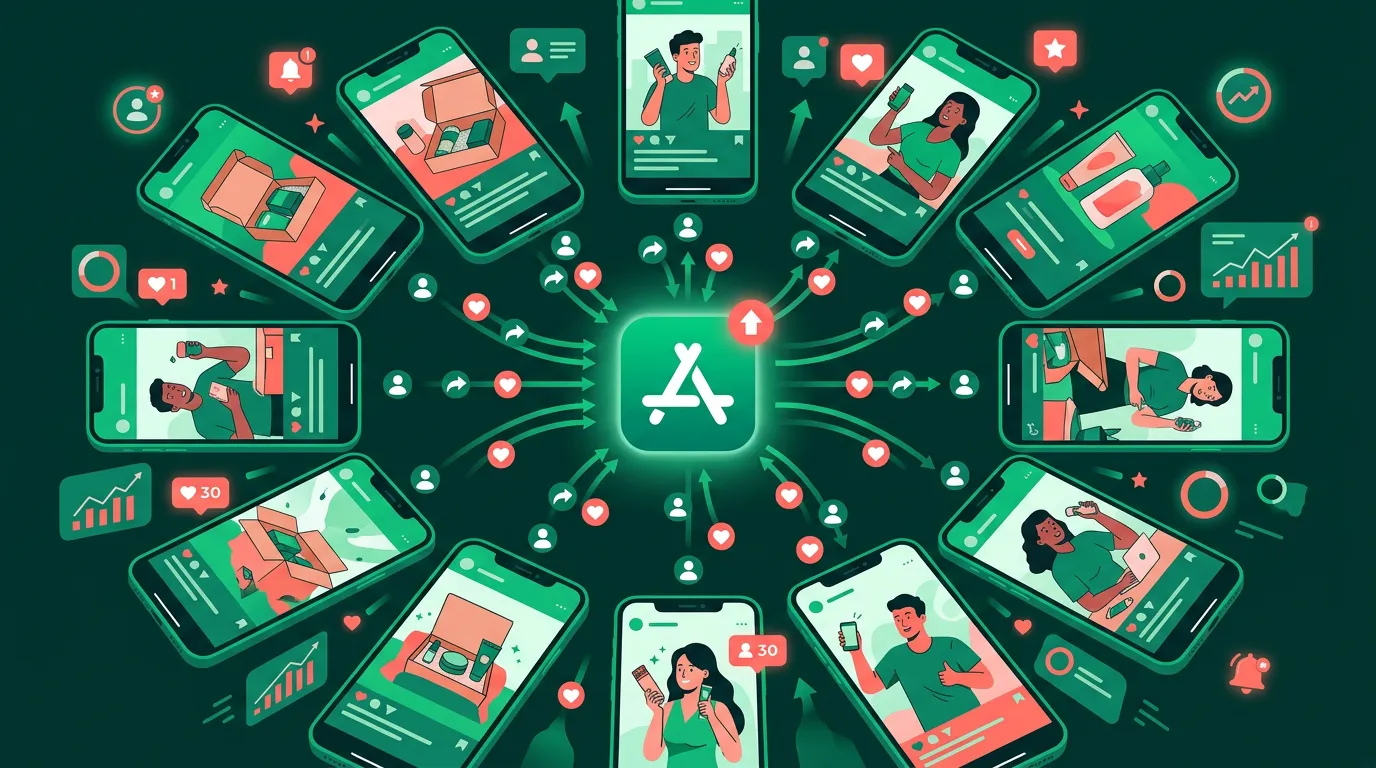
Table of Contents
Why UGC and Influencer Marketing Beats Paid Ads for App Launches
"Use influencer and UGC partnerships as the primary customer acquisition channel instead of paid ads." — Key lesson from 69 videos analyzed, frequency score: 15
Cal AI, Tabs chocolate, NGL, and multiple AI apps grew primarily through micro-influencer campaigns costing $50–$500 per creator, achieving better ROI than traditional paid advertising. This was the highest-frequency lesson across all 69 videos analyzed from thebrettway, appearing 15 times across the dataset. The pattern is consistent: apps that launch with influencer-first distribution outperform those that rely on paid ads, particularly in the critical zero-to-10,000 user phase.
The reason is structural. Paid ads require you to interrupt someone's attention and convince them to act. UGC and influencer content is native to the platform — it looks like content the viewer chose to watch, not an ad they are forced to endure. When a creator with 10,000 followers shows themselves using Cal AI to track their fitness or unboxing Tabs chocolate, their audience processes it as a recommendation from someone they trust, not a corporate message.
Why Micro-Influencers Outperform Paid Ads for App Launches
Trust transfer. A creator recommending your app transfers their credibility to your product. Paid ads start from zero trust. NGL grew as a viral social app precisely because influencer distribution made it feel like a peer recommendation.
Lower cost per acquisition. Tabs chocolate turned $100 into $80K profit by paying just two creators. Comparable reach through paid ads on TikTok or Instagram would cost thousands with lower conversion rates.
Content compounds. A paid ad stops working when you stop paying. A TikTok video from a creator can continue generating views and installs for weeks or months. Louis generated 48 million views on a single TikTok video — organic reach that no ad budget could replicate.
Algorithm-friendly. TikTok, Instagram Reels, and YouTube Shorts algorithms favor authentic-looking content over polished ads. UGC-style creator content gets more distribution because it keeps users on the platform longer.
| Case Study | Investment | Result |
|---|---|---|
| Tabs chocolate (Blake Anderson) | $100 in two creators | $80K profit on day one |
| Cal AI | $50–$500 per creator | Primary growth channel for AI fitness app |
| Nikita and Yini | TikTok-first content | 250K signups from 9M TikTok views |
| Louis (Glow Up) | Short-form video strategy | 48M views on one TikTok, $800K in 365 days |
The $50–$500 Micro-Influencer Playbook
"How do you find and land your first clients?" — Most asked viewer question (45 occurrences, 3,200 likes)
The Tabs chocolate case study is the clearest proof of concept in the dataset. Blake Anderson invested $100 total — paying two micro-influencers to create content about the product — and generated $80K in profit on launch day. The math is not complicated: when a creator with an engaged audience of 10,000–50,000 followers genuinely recommends a product, the conversion rates dwarf anything achievable through paid channels at the same price point.
Step 1: Start with $50–$100 Test Posts
Do not commit $500 to a creator you have never worked with. Start with a small test: $50–$100 for a single piece of content. Measure engagement rate, click-throughs, and actual conversions. Tabs chocolate validated their entire influencer strategy with just two $50 posts before scaling. Cal AI used the same micro-budget approach, testing dozens of creators at low cost before doubling down on the ones who converted.
The heuristic: If a $50 test post generates any measurable installs or sales, that creator is worth scaling to $200–$500 for a more produced piece of content.
Step 2: Structure Performance-Aligned Deals
The most effective deal structure combines a small flat fee with performance upside. Pay $50–$100 as a base rate to cover the creator's time, then add a percentage of sales or a per-install bonus through a unique referral code. This aligns incentives: the creator is motivated to make content that actually converts, not just content that looks good. Every product mentioned frequently in the dataset — Cal AI (5 mentions), NGL (3 mentions), Tabs (2 mentions) — used some form of performance tracking.
Step 3: Run 10–20 Creators Simultaneously
The portfolio approach applies to influencer campaigns the same way it applies to startup ideas. Most creator posts will underperform. A few will massively outperform. You need volume to find the winners. Nikita and Yini did not get 250K signups from one video — they generated 9 million views across multiple pieces of TikTok content. Run 10–20 creators in your first campaign, measure results within 48 hours, and reinvest in the top performers.
Budget Allocation Framework
First $500: 10 test posts at $50 each across different creator profiles and platforms
Next $1,000: Scale the top 3–5 performing creators to $200–$300 for higher-production content
Next $2,500: Lock in top performers on monthly retainers of $300–$500, recruit 10 new test creators
Key Takeaway
The $50-$500 per creator range is not a budget constraint -- it is an advantage. At that price point you can test 10-20 creators simultaneously, and the math works even if 80% of posts underperform. Tabs chocolate turned $100 into $80K profit from just two creators. The portfolio approach means your first campaign is also your market research: you learn which creator profiles, platforms, and content angles convert before spending real money.
TikTok-First Launch Strategy: From Zero to Viral
"How do I get my app or service noticed with no existing audience or following?" — Second most asked viewer question (35 occurrences, 2,100 likes)
Content creation as a business engine was the highest-frequency theme across the entire dataset, appearing 22 times. The specific focus: using short-form video on TikTok, YouTube Shorts, and Snapchat as the primary growth lever. TikTok dominates as the launch platform because its algorithm gives every piece of content a fair shot at reach regardless of the account's follower count. This makes it the only major platform where a brand-new account can reach millions of people organically.
TikTok Case Studies
- • Nikita and Yini — 9 million TikTok views converted into 250K signups. The content was native, authentic, and showed real product usage.
- • Louis (Glow Up) — 48 million views on a single TikTok video. Built Glow Up to $800K in revenue within 365 days using TikTok as the primary channel.
- • NGL — Grew as a viral social app by leveraging influencer distribution on TikTok. The app's mechanics were designed to generate shareable content.
Platform Mentions in Dataset
- • TikTok Shop — 6 mentions. The most referenced platform for product-based launches and direct commerce.
- • Instagram/Reels — 4 mentions. Strong secondary channel for retargeting and brand building.
- • CapCut — 3 mentions. The go-to editing tool for creating TikTok-native content quickly.
- • Crayo AI — 3 mentions. AI-powered content creation tool for scaling short-form video production.
The TikTok-first strategy works because you are meeting the audience where they already spend time and presenting your product in the format they already consume. Cal AI, built by a teenager, used this exact playbook: micro-influencer campaigns on TikTok where creators showed real fitness tracking results. The content felt native to the platform because it was — short, authentic, results-focused.
The multi-platform cascade: Launch on TikTok first for maximum organic reach, then repurpose winning content to Instagram Reels and YouTube Shorts. CapCut (3 mentions) and Crayo AI (3 mentions) are the tools used to adapt content across platforms efficiently. The same core video can be reformatted for each platform's specifications without recreating from scratch.
Before investing in influencer campaigns, make sure your product idea has been validated with real audience data. Our idea validation guide covers how to use YouTube comment data to test demand signals before spending on distribution.
Finding and Vetting Creators: The Selection Framework
The question of how to find creators when you have no audience was the second most common viewer question in the dataset, appearing 35 times with 2,100 total likes. The answer from the case studies is surprisingly systematic: you do not need connections or a big brand name. You need a clear offer, a direct message, and a willingness to test many creators at small budgets before scaling the winners.
Search by Hashtag, Not by Follower Count
Search TikTok and Instagram for hashtags related to your app category. If you are launching a fitness app like Cal AI, search hashtags like #fitnessjourney, #caloriecounting, #mealprep. Look for creators who are already making content in your space with 1,000–50,000 followers. These creators have engaged niche audiences and are far more responsive to outreach than larger accounts. Cal AI (mentioned 5 times in the dataset) grew by finding fitness creators at this exact scale.
The Engagement Rate Filter
Follower count is vanity. Engagement rate is the metric that predicts conversion. A creator with 5,000 followers and a 10% engagement rate will outperform a creator with 100,000 followers and 0.5% engagement every time. Calculate engagement rate by dividing total interactions (likes, comments, shares) on their last 10 posts by their follower count. Target creators above 5% engagement. The products that succeeded in the dataset — Tabs, Cal AI, Gel Blasters (2 mentions) — all worked with high-engagement micro-creators.
The Direct Outreach Template
DM creators directly with a message that is specific, respectful, and includes a clear offer. Lead with what you liked about their content. State exactly what you are offering: free product access, a flat fee, and a performance bonus through a referral code. Tabs chocolate's Blake Anderson reached out cold to two creators with a simple, direct pitch and a $50 offer each. The creators said yes because the offer was clear and low-commitment.
Response rate heuristic: Expect a 10–20% response rate on cold DMs to micro-influencers. Send 50–100 outreach messages to build a roster of 10–20 active creators for your first campaign.
The Content Brief: What to Tell Creators to Maximize Conversion
"Content Creation as a Business Engine" — Highest-frequency theme across 69 videos (frequency: 22), emphasizing short-form video as the primary growth lever
The content that converts is not the content that looks the most professional. It is the content that looks the most native to the platform. Every successful case study in the dataset used UGC-style content: real people, real reactions, real use cases. Cal AI's creators showed actual fitness tracking results on their phones. Tabs chocolate creators filmed genuine unboxing reactions. The content worked because it was indistinguishable from the organic content the audience was already scrolling through.
What the Brief Should Include
The hook (first 2 seconds). The opening frame determines whether the viewer keeps scrolling or stops. Give the creator 2–3 hook options: a surprising result, a bold claim, or a question. Do not script it word for word — let them deliver it in their own voice.
The demonstration (10–20 seconds). Show the product in action. For Cal AI, this was pointing the phone camera at food and showing the calorie count. For Gel Blasters, it was showing the product being used in real scenarios. Screen recordings, real-time usage, and before/after comparisons all work.
The call to action (last 3 seconds). A simple, direct instruction: "Link in bio" or "Use my code for 20% off." Do not overcomplicate it. The CTA should feel like part of the recommendation, not a separate ad segment.
What NOT to include. No brand logos in the opening. No scripted testimonials. No corporate language. The content should feel like a creator sharing a discovery, not reading ad copy. The 62% positive sentiment across 12,043 comments confirms that audiences in this space respond to authenticity.
Content Format by Platform
| Platform | Optimal Length | Best Format |
|---|---|---|
| TikTok | 15–30 seconds | Native UGC, trending sounds, authentic reactions |
| Instagram Reels | 15–30 seconds | Polished UGC, carousel follow-ups, story amplification |
| YouTube Shorts | 30–60 seconds | Tutorial-style demos, problem-solution format |
| TikTok Shop | 30–60 seconds | Product showcase with in-app purchase link |
Find Creators Worth Partnering With
Taffy analyzes YouTube channel engagement and audience sentiment to identify creators whose audiences match your target market. Data-driven creator selection, not guesswork.
Measuring ROI: Tracking Attribution from Influencer Campaigns
Attribution is the difference between scaling intelligently and burning money. Tabs chocolate could trace their $80K day-one profit directly to two specific creators because they used unique referral codes. Without attribution, you know influencer marketing works in aggregate but you cannot identify which creators to scale and which to cut. Every dollar spent on a creator without tracking is a dollar you cannot learn from.
Unique Referral Codes Per Creator
Assign each creator a unique discount code or referral link. This is the simplest and most reliable attribution method. When a user signs up or makes a purchase with code "CREATOR_JANE20," you know exactly which creator drove that conversion. Track total uses, revenue per code, and cost per acquisition per creator. This is how Tabs chocolate measured their $80K launch day — each creator had a unique code.
Custom Landing Pages and Deep Links
For app launches, use deep links that take users from the creator's content directly to your app store listing with UTM parameters. Create a unique landing page URL for each creator: yourapp.com/creator-jane. Track visits, app store click-throughs, and installs per page. Compare install spikes against content posting times to confirm attribution even when users do not use the referral code.
The Metrics That Matter
Cost per install (CPI): Total creator payment divided by tracked installs. Compare against paid ad CPI to confirm influencer marketing ROI advantage.
7-day retention per creator: Users acquired from different creators retain at different rates. A creator who drives 100 installs with 40% retention is more valuable than one who drives 200 installs with 5% retention.
Revenue per creator dollar spent: Tabs chocolate's $100 investment generating $80K represents an 800x return. Track this metric per creator to identify outliers worth scaling.
Content shelf life: How long does a creator's post continue to generate installs? TikTok content can drive installs for weeks after posting. Factor ongoing returns into your ROI calculation.
Scaling Beyond Launch: From 10K to 100K Users
"Glow Up made $800K in 365 days" — Louis scaled from a single viral TikTok to a systematic creator program
Getting to 10,000 users proves the model works. Scaling to 100,000 requires systematizing what worked. Louis went from 48 million views on a single TikTok to building Glow Up into an $800K business in 365 days by doing exactly this: identifying what content formats, creator profiles, and distribution channels drove the best results, then replicating the pattern at scale.
Phase 1: Identify the Winning Creator Profile
After your initial campaign of 10–20 creators, analyze which ones drove the most installs and best retention. Look for patterns: follower count range, content style, audience demographics, platform. Cal AI discovered that fitness-focused creators with 5,000–20,000 followers on TikTok converted best. Once you have the profile, recruit more creators who match it.
Phase 2: Build a Creator Pipeline
Transition from one-off collaborations to ongoing partnerships. Lock in your top 5–10 creators on monthly retainers. Simultaneously, maintain a pipeline of 20–30 new creators being tested each month at the $50–$100 level. The portfolio approach ensures you continuously discover new high-performers while maintaining consistency from proven ones. TikTok Shop (6 mentions) enables creators to link products directly in their content, reducing friction.
Phase 3: Cross-Platform Expansion
Once TikTok is generating consistent installs, expand to Instagram Reels (4 mentions in dataset) and YouTube Shorts. Repurpose winning TikTok content using CapCut (3 mentions) and Crayo AI (3 mentions) to adapt for each platform. Nikita and Yini's 250K signups came from a TikTok-first approach, but the subsequent growth involved expanding to multiple platforms with the same content strategy adapted for each algorithm.
Phase 4: From UGC to Brand
As you scale past 50K users, the influencer program transitions from your primary acquisition channel to one of several. Tabs chocolate evolved from two creators at $50 each to a systematic influencer program. The user-generated content from your early campaigns becomes social proof for your brand, which in turn makes it easier to recruit larger creators and negotiate better rates. The flywheel compounds.
The Scaling Principle
The pattern across every case study in the dataset is the same: start small, measure ruthlessly, double down on what works, and cut what does not. Tabs chocolate did not start with a $10,000 influencer budget. They started with $100. Cal AI did not sign 100 creators on day one. They tested micro-campaigns at $50–$500 per creator. Louis did not plan for 48 million views. He made content consistently until the algorithm rewarded one video massively. The scaling strategy is not a strategy at all — it is disciplined iteration.
Our take
The most counterintuitive finding across all 69 videos is that creator follower count barely correlates with campaign performance. Tabs chocolate's $80K return came from creators with modest followings. Cal AI's best-performing campaigns came from fitness creators in the 5K-20K follower range, not the 100K+ accounts. The reason is engagement concentration: smaller creators have a higher percentage of followers who actually see and act on their content. For app launches specifically, 20 creators at $50 each will almost always outperform one creator at $1,000. The portfolio approach is not just cheaper -- it generates better data about what works.
For help finding your first users once the influencer campaign is live, our finding early users guide covers how to convert initial attention into an active user base. And for the broader marketing playbook, our micro-SaaS marketing guide shows how influencer campaigns fit into a complete distribution strategy.
Frequently Asked Questions
How much should I pay micro-influencers for app promotion?
Based on 69 videos and 12,043 comments analyzed from thebrettway, micro-influencer campaigns typically cost $50–$500 per creator. Tabs chocolate invested just $100 in two creators and generated $80K profit on day one. Cal AI grew primarily through micro-influencer campaigns in this price range. The key is not how much you pay but how you structure the deal: performance-based bonuses, affiliate codes, and revenue sharing keep costs aligned with results. Start with $50–$100 test posts before committing larger budgets to creators who prove they can convert.
Is TikTok or Instagram better for app launch campaigns?
TikTok is the dominant launch platform based on the case studies analyzed. Nikita and Yini got 250K signups from 9 million TikTok views. Louis generated 48 million views on a single TikTok video, and Glow Up made $800K in 365 days. TikTok's algorithm gives new accounts and new content a fair shot at reach regardless of follower count, making it ideal for launch-phase apps. Instagram Reels is a strong secondary channel, mentioned 4 times across the dataset, and works best for retargeting and building long-term brand presence after the initial TikTok spike.
How do I find my first influencers with no existing audience?
This was the second most asked question in the comment data, appearing 35 times with 2,100 likes. The approach from thebrettway's case studies is to start with creators who have 1,000–50,000 followers in your niche. Search TikTok and Instagram hashtags relevant to your app category. Look for creators with high engagement rates (above 5%) rather than high follower counts. DM them directly with a clear offer: free product access plus a flat fee of $50–$100 for a test post. Tabs chocolate found their first two creators this way and turned $100 into $80K.
What type of content should influencers create for my app?
UGC-style content that looks native to the platform consistently outperforms polished ads. The content creation theme appeared 22 times across the dataset, emphasizing short-form video on TikTok, YouTube Shorts, and Snapchat as the primary growth lever. The brief should focus on the creator showing a genuine reaction to or use of the product, not reading a script. Cal AI's creators showed real fitness tracking results. Tabs chocolate creators showed authentic unboxing reactions. The content should feel like a recommendation from a friend, not an advertisement.
How do I track ROI from influencer campaigns?
Attribution is tracked through unique referral codes, custom landing pages, and UTM parameters assigned to each creator. Every creator should have a unique discount code or referral link so you can measure exactly how many installs and conversions each one drives. Tabs chocolate tracked their $80K day-one profit directly back to two specific creators. For app launches, use deep links that take users from the creator's content directly to your app store listing, and compare install spikes against content posting times. Start measuring cost per install and 7-day retention per creator to identify which partnerships to scale.
Research Your App Launch Strategy
Taffy lets you analyze any YouTube channel to extract growth strategies, audience questions, and competitor playbooks from transcripts and comments. Use it to find creators in your niche, understand what content converts, and validate your launch approach before spending a dollar.



Written by
Arun Agrahri
Builder of Taffy. I spend most of my time analyzing YouTube channels to find patterns others miss. These guides are the result of processing thousands of videos and comments through our data pipeline.
Get the next guide first
We publish deep-dive research guides weekly. Be the first to know when new analysis drops.
No spam. Unsubscribe anytime.