App Idea Validation Playbook: Pre-Sell Before You Build
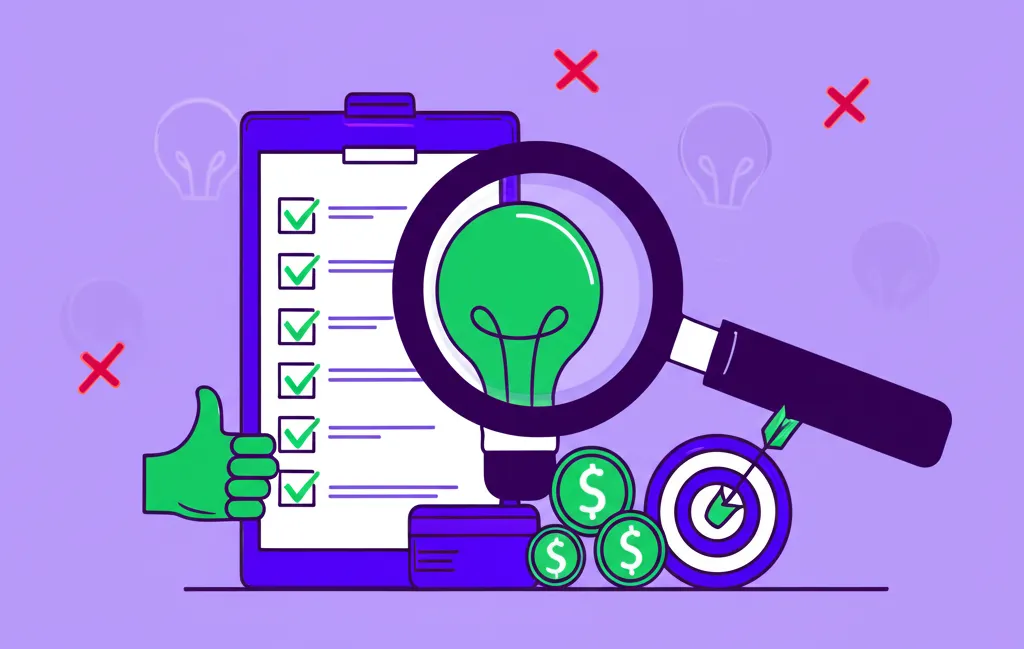
You have the technical skills to build anything -- but the graveyard of failed SaaS products is full of apps that solved problems nobody actually had. 49 micro-SaaS founders on Starter Story shared how they validated ideas before writing a single line of code, using frameworks that reduce startup risk to near zero.
Jump to a section:
"Finding an idea is the easy part. The hard part is actually getting revenue, distribution and marketing." This comment had 266 upvotes. And it's exactly backwards.
The founders we studied didn't struggle with marketing after building. They validated demand BEFORE building. Multiple founders explicitly mentioned getting paid before writing a single line of code.
Here's the complete validation playbook that emerged from 49 founder interviews.
How Do You Tell If Your Idea Is a Painkiller or a Vitamin?
"People aren't asking for new features; they're asking for pain relief." — Andy, Data Fetcher
You tell whether your idea is a painkiller or a vitamin by asking one question: "Would someone pay $20/month to make this problem disappear?" Painkillers solve urgent, annoying problems that people actively seek solutions for. Vitamins are "nice to have." People pay for painkillers. They forget to take vitamins.
How to Identify Painkiller Problems
Look for complaint threads
EUform's founder found his opportunity when Typeform raised prices. Reddit and Twitter exploded with complaints. That public pain became his market.
Find the 30-minute frustration
Andy's framework: "Your micro-SaaS should aim to be the '1-Click Fix' for tasks that currently take 30 minutes of frustrating manual work." The deeper the pain, the higher you can charge.
Check if people are already paying
If competitors exist and have paying customers, the market is validated. You just need to be better, cheaper, or more focused.
The litmus test:
Ask yourself: "Would someone pay $20/month to make this problem disappear?" If the answer isn't an obvious yes, it's probably a vitamin.
Key Takeaway
The $20/month test is the single most reliable validation filter in the dataset. Not 'would someone use this for free' -- would someone pay $20/month to make this problem disappear? If you have to think about it for more than 5 seconds, you are probably building a vitamin, not a painkiller.
Is Copying an Existing App a Valid Startup Strategy?
"Copying successful apps is a valid and profitable strategy." — Pattern from multiple $50K+/month founders
Yes, copying an existing app is a valid and often profitable startup strategy because the original product already proved market demand. Multiple founders built $10-50K/month businesses by cloning existing successful apps with small improvements. One comment had 178 upvotes: "I'm going to copy his app."
Andy from Data Fetcher calls it "borrowing a proven pattern." He saw a successful Google Sheets add-on and rebuilt it for Airtable. Same concept, different platform.
How to Clone Ethically and Effectively
- Find proven products. Look at Chrome Web Store, Shopify App Store, or Airtable Marketplace bestsellers. These are validated by real paying customers.
- Identify the gap. Read negative reviews. What are people complaining about? Missing feature? Bad support? High price? That's your angle.
- Choose a different platform or niche. Rebuild for a different marketplace, or target a specific industry the original ignored.
- Be 1% different, 10% better. You don't need revolutionary innovation. Slightly better UX, lower price, or better support can win.
Counter-intuitive truth:
Original ideas are riskier than copies. The original product already proved market demand. You're just reducing friction or improving execution.
Once you have validated demand, the next challenge is getting your first customers. Our early user acquisition guide covers 14 strategies from 50 founders who solved that exact problem.
Where Do You Find Demand Signals Before Building?
You find demand signals before building by searching Reddit complaint threads, reading competitor negative reviews on G2 and Capterra, watching for pricing backlash events, and checking YouTube comments on tutorial videos. The founders we studied found these signals before building anything, using them as evidence that people would actually pay for a solution.
Where to Find Demand Signals
Reddit complaint threads
Search "[your niche] sucks" or "[competitor] alternative" on Reddit. Threads with 50+ upvotes indicate real demand. Read every comment—the specific complaints reveal what to build.
Competitor negative reviews
G2, Capterra, and App Store reviews are goldmines. Filter by 1-2 star reviews. The recurring complaints are your feature roadmap.
Pricing backlash
When a popular tool raises prices, users publicly complain. EUform launched right after Typeform's price increase. Perfect timing.
Feature request forums
Many SaaS products have public feature request boards. The most-upvoted requests that never get built? Those are product opportunities.
YouTube comments
Tutorial videos about solving problems manually reveal automation opportunities. Comments asking "is there a tool for this?" are direct demand signals.
Andy's 6-Step Framework:
- Identify a growing platform
- Find a pain point on that platform
- Borrow a proven pattern from elsewhere
- Check integration capabilities
- Calculate opportunity size
- Assess platform risk
How Do You Pre-Sell a Product That Doesn't Exist Yet?
"Selling before building reduces risk to near zero." — Pattern from interviews
You pre-sell a product that doesn't exist yet by using landing pages with waitlists, discounted lifetime deals, fake demo videos, or concierge MVPs where you deliver the service manually first. Multiple founders mentioned getting paid before writing code. One ran a pre-sale earning $20K before the product existed. Another used lifetime deal launches to fund development.
Pre-Sale Methods That Work
Landing page + waitlist
Create a landing page describing the problem and solution. Collect emails. If you can't get 100 signups in 2 weeks, the idea might not have enough demand.
Lifetime deal pre-launch
Offer a discounted lifetime deal before the product is built. "Pay $49 now, get lifetime access when we launch." Real money = real validation.
Fake demo video
Create a mockup or prototype video showing the product in action. Post to Twitter or TikTok. If it goes viral, build it. If not, try a different idea.
Concierge MVP
Offer the service manually before automating. Find 5 customers and solve their problem by hand. Charge full price. Then build the software.
Key insight:
"Validate with money, not just feedback." Surveys and compliments mean nothing. Credit card transactions are the only true validation.
Ready to Build Fast After Validating?
Our Rapid Startup Playbook covers the build-and-flip framework for taking a validated idea to revenue in weeks, not months.
Should You Validate by Building on an Existing Platform?
Yes, validating by building on an existing platform is one of the fastest paths because the platform provides built-in distribution and you don't have to find customers. Andy's approach was to find a growing platform first, then look for problems to solve. Customers are already browsing the marketplace looking for solutions.
High-Opportunity Platforms in 2025
Airtable
Growing marketplace, power users willing to pay
Notion
Huge user base, templates and integrations in demand
Figma
Designers with budgets, plugin ecosystem growing
Shopify
Merchants with revenue, willing to pay for optimization
Chrome Web Store
Massive distribution, low competition in niches
Roblox
$10M+/year developers, underexplored for tools
Platform risk warning:
Andy warns about platform dependency. Don't build on platforms that could shut down your access. Evaluate: "If this platform killed my integration tomorrow, would I survive?"
When Should You Kill a Startup Idea?
"Be willing to quit projects that aren't working. Don't get emotionally attached." — Pattern from successful founders
You should kill a startup idea when you see clear kill signals: no waitlist signups in two weeks, no pre-sales after launching an offer, lukewarm feedback, or having to over-explain the value proposition. The successful founders we studied killed ideas quickly. They didn't spend years on projects that weren't working. Data and traction drove decisions, not emotional investment.
Kill Signals to Watch For
No waitlist signups in 2 weeks
If you can't get 100 email signups with a landing page, the messaging or the idea isn't resonating.
No pre-sales after launching offer
If nobody pays for a discounted pre-launch offer, they won't pay full price later. Move on.
Feedback is lukewarm
"That's interesting" means no. You want "I need this NOW." Polite interest isn't enough.
You're explaining too much
If people don't immediately understand the value, the problem isn't painful enough or your positioning is wrong.
Counter-intuitive truth from the data:
Successful founders report 5-20 failed projects before their first success. Killing bad ideas fast is how you get to good ideas faster. For more on the marketing side once you do validate, see our micro-SaaS marketing playbook.
Our take
The validation frameworks in this guide assume you are building something new. But the strongest signal in the data is that building something new is usually the wrong move. The founders with the fastest path to revenue were the ones who found a product that already works, identified a specific complaint, and built a better version. Validation is instant because the market already exists. The idea validation step becomes execution validation: can I build this better, cheaper, or for a more specific audience?
Research Any Niche Before Building
Taffy lets you analyze YouTube comments to find pain points, feature requests, and demand signals. See what people actually complain about before you start building.
Frequently Asked Questions
How do I validate a startup idea before building?
The most effective method: pre-sell before building. Create a landing page, run a pre-sale campaign, or launch on AppSumo before writing code. If people won't pay for something that doesn't exist, they won't pay after you build it.
Is copying an existing app a valid strategy?
Yes. Multiple founders built $10-50K/month businesses by cloning successful apps with small improvements. The original product already proved market demand—you're just improving execution.
How long should idea validation take?
2-4 weeks maximum. Founders who spend months "researching" often never launch. If you can't find validation signals quickly, the idea may not be strong enough.
Should I build an MVP or validate first?
Validate first. A landing page, fake demo video, or pre-sale can prove demand with zero development time. Only build after you have paying customers or a substantial waitlist.
What if my idea is "too original" to copy?
Original ideas are actually riskier. If nobody else is solving this problem, ask why. Often it's because the market is too small or the problem isn't painful enough to pay for.
Want to explore more founder frameworks?
See the full Starter Story channel analysis with themes, lessons, and counter-intuitive truths.
Explore @starterstory Analysis


Written by
Arun Agrahri
Builder of Taffy. I spend most of my time analyzing YouTube channels to find patterns others miss. These guides are the result of processing thousands of videos and comments through our data pipeline.
Get the next guide first
We publish deep-dive research guides weekly. Be the first to know when new analysis drops.
No spam. Unsubscribe anytime.