Revenue Verification Playbook: How to Spot Real vs Fake Income Claims
"Prove it." That two-word challenge shows up hundreds of times across 12,043 comments on thebrettway's 69 videos. Audiences have learned to distrust income claims -- and the founders who break through that skepticism share specific verification frameworks that separate credible revenue stories from guru theater.
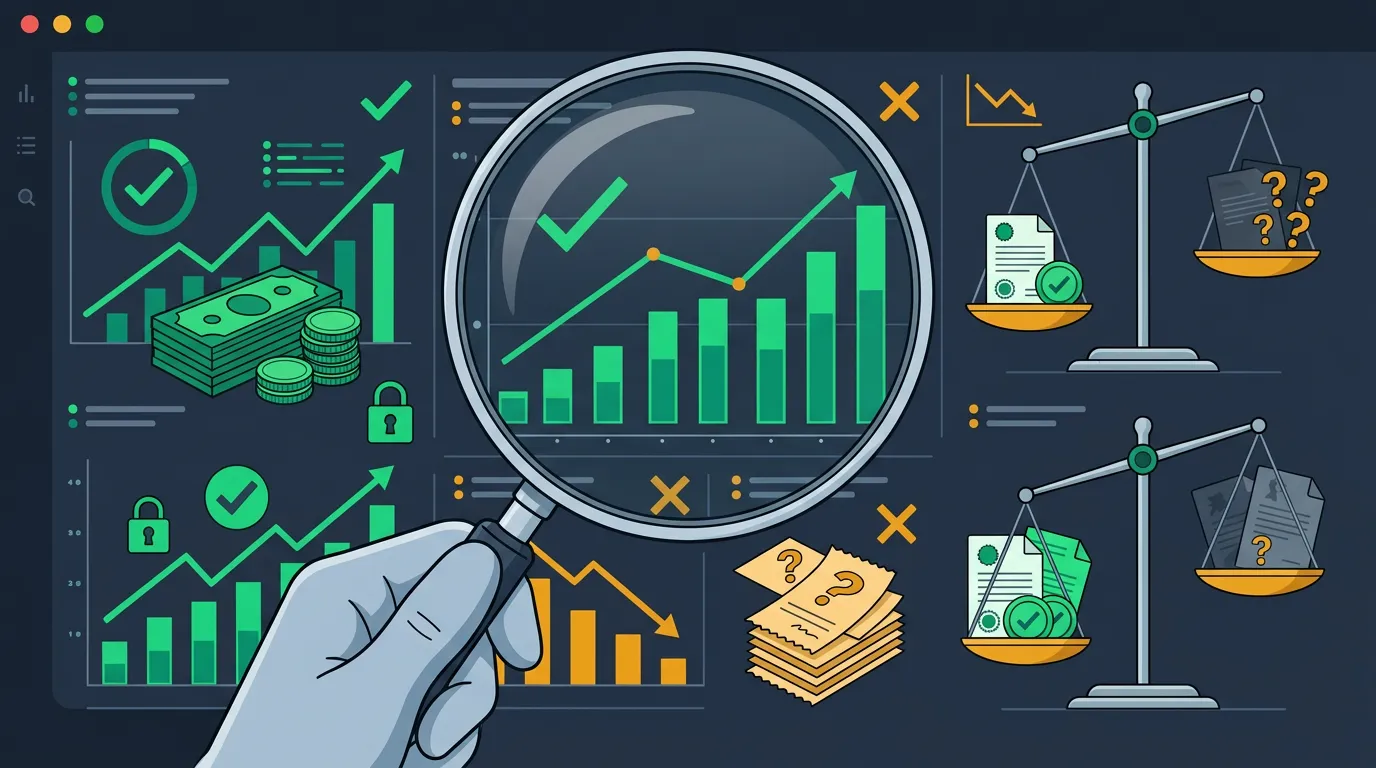
Table of Contents
Why Revenue Skepticism Is Actually Healthy
"brett could you start making the guests prove that they make this money? Because to me it just seems like Blake was throwing numbers around especially when his app reviews are dog shit." — Viewer comment, 306 likes
Revenue skepticism is not cynicism. It is pattern recognition. Across 69 videos and 12,043 comments on thebrettway, the single most recurring viewer concern — appearing 52 times with 3,650 likes — asks a direct question: "Are these income claims real or are guests just selling pipe dreams and courses?" This is not a fringe opinion. It is the dominant audience signal.
The data tells a clear story. Revenue skepticism appeared in 22 distinct comment threads, generating 1,800 total engagement. Viewers are not rejecting entrepreneurship content. They are demanding higher standards of evidence. When someone claims to make six or seven figures from an app whose reviews are, as one 306-like comment put it, "dog shit," the audience notices the gap between claim and reality.
Why Skepticism Signals a Sophisticated Audience
They cross-reference claims with public data. Viewers check app store reviews, download estimates, and product quality before accepting revenue numbers at face value.
They test the tools themselves. As one comment with 237 likes stated: "As an actual programmer who has used the tools you guys speak of I can say you're definitely selling pipe dreams." Direct experience exposes the gap between marketing and reality.
They distinguish between revenue and profit. Savvy viewers know that claiming revenue without discussing margins, costs, and net income is a common tactic to inflate perceived success.
The overall sentiment across thebrettway's audience is 62% positive, 23% neutral, and 15% negative. That 15% negative sentiment is overwhelmingly concentrated around revenue verification concerns. This means the audience is broadly supportive of the content but intensely critical of unverified claims. The takeaway for both viewers and creators: skepticism is a feature, not a bug. It pushes the entire ecosystem toward higher quality evidence.
Key Takeaway
Revenue skepticism at 15% negative sentiment is 3-4x higher than health channels like Huberman (4%) or Attia (6%). This is not because the audience is hostile -- 62% positive confirms broad support. It is because income claims trigger a specific verification reflex that health advice does not. The audience applies a higher burden of proof to money claims than to supplement recommendations, which tells you something important about trust calibration across content categories.
The 7 Red Flags of Fake Income Claims
From analyzing 7,318 substantive comments (61% of the total 12,043), we extracted the patterns viewers consistently flag when they suspect a guest is exaggerating or fabricating revenue claims. These seven red flags appeared repeatedly across the 22 skepticism threads.
Red Flag 1: No Verifiable Product or Business
The guest claims revenue but has no product you can find, download, or purchase. No website, no app store listing, no public presence. If the business cannot be independently located, the revenue claim cannot be independently verified.
Red Flag 2: Revenue Numbers That Shift Between Appearances
When a guest appears on multiple podcasts and the claimed numbers change significantly without a clear timeline or explanation, viewers notice. Consistent storytelling with specific, dated milestones is a sign of authenticity. Vague, escalating numbers are not.
Red Flag 3: The Course Is the Business
When the primary revenue source appears to be selling courses about making money rather than the business the course teaches about, viewers are right to be skeptical. The question from thebrettway's audience is pointed: are guests making money from the business or from telling others they can make money?
Red Flag 4: Product Quality Contradicts Revenue Claims
This is the red flag that generated the most engagement. When a guest claims significant app revenue but the app has poor reviews and low ratings, the numbers do not add up. The 306-like comment calling out a guest whose "app reviews are dog shit" captures this perfectly.
Red Flag 5: Refusal to Show Proof
When asked for dashboards, screenshots, or any form of verification, evasion or deflection is a strong negative signal. Founders with legitimate revenue have no reason to hide it. The audience demand is clear: 12 direct requests for guest revenue verification with 480 likes.
Red Flag 6: Vague Revenue Language
Phrases like "multiple six figures," "high five figures," or "crushing it" without specific dollar amounts, timeframes, or context are designed to imply more than they state. Real founders tend to cite specific numbers with specific dates because they track their metrics closely.
Red Flag 7: Lifestyle Flexing Over Business Substance
When a guest spends more time discussing their lifestyle, possessions, or freedom than the actual mechanics of their business, the revenue claim is likely doing more marketing work than truth-telling. Real founders talk about customer acquisition costs, churn rates, and margins. Fake gurus talk about Lamborghinis.
Analyze Any Channel's Audience Skepticism
Taffy analyzes thousands of YouTube comments to surface audience pain points, skepticism patterns, and content opportunities. See what viewers are really thinking.
The Verification Framework: 5 Ways to Prove Revenue
"Everyone claims revenue numbers. Nobody proves them. Until now." — Content intelligence insight from thebrettway analysis, 22 questions, 1,080 total engagement
The demand for revenue-verified founder case studies is the number one content intelligence opportunity identified from thebrettway's audience data. With 22 questions and 1,080 total engagement, viewers are not just skeptical — they are actively requesting a verification framework. Here are five methods that work across different business types.
Method 1: App Store Cross-Referencing
Best for: Mobile apps, SaaS products with app store presence
Check app store rankings, review counts, and rating quality against claimed revenue. An app claiming $100K/month in revenue should have a visible user base. Poor reviews with high claimed revenue is the exact pattern that triggered the most skepticism in thebrettway's comments — the 306-like comment specifically cited "dog shit" app reviews as evidence of inflated claims.
Verification tools: Sensor Tower, data.ai, AppFollow for download estimates and revenue modeling based on category benchmarks.
Method 2: Public Metrics and Third-Party Data
Best for: SaaS, content businesses, e-commerce
SimilarWeb provides traffic estimates. IndieHackers and open startup pages show self-reported but historically tracked metrics. Social Blade estimates YouTube revenue ranges. For e-commerce, marketplace seller ratings and shipping volume indicators provide independent data points. The key principle: triangulate from multiple independent sources rather than relying on a single claim.
Verification tools: SimilarWeb, Social Blade, BuiltWith, IndieHackers open revenue pages.
Method 3: Customer and Review Validation
Best for: Service businesses, B2B products, agencies
Real customers leave real traces. LinkedIn recommendations from named clients, public case studies with verifiable companies, G2 or Capterra reviews with identifiable reviewers, and testimonials that can be fact-checked all serve as revenue proxies. A founder claiming $1M/year from a service business should have a visible trail of satisfied clients.
Verification tools: LinkedIn, G2, Capterra, Trustpilot, Google Business reviews.
Method 4: Financial Document Verification
Best for: High-credibility claims, investment contexts
The gold standard is showing actual financial documents: Stripe dashboards, bank statements, tax returns, or audited financials. This is what thebrettway's audience is explicitly requesting with 12 direct asks and 480 likes. Founders who voluntarily share screenshots of their revenue dashboards build immediate credibility.
What to look for: Date ranges on dashboards, consistency between claimed numbers and shown data, and whether the document is current or cherry-picked from a peak period.
Method 5: Audience Corroboration Through Comments
Best for: Any public-facing business or creator
Comment sections are an underutilized verification layer. When real users of a product show up in comments confirming or denying claims, that is organic, hard-to-fake evidence. The 237-like comment from a programmer who "used the tools you guys speak of" and concluded they were "pipe dreams" is exactly this type of audience-sourced verification.
How Taffy helps: Taffy analyzes thousands of comments to surface these audience verification signals, categorizing them by sentiment, engagement, and substance.
Verify Revenue Claims With Data
Taffy analyzes YouTube comment sections to surface audience skepticism patterns, verification requests, and credibility signals across any business content channel.
The validation mindset from comment analysis applies broadly to entrepreneurship content. Our idea validation guide covers how to test business ideas using similar audience data before committing resources.
What Real Founders Look Like vs. Fake Gurus
Two key lessons emerged from the thebrettway dataset with the highest frequency. The first, appearing 14 times: "Solve your own problem first, then productize the solution for others." The second, appearing 10 times: "Validate demand before building by pre-selling or running a manual version." These are the behavioral signatures of real founders. Fake gurus do neither.
| Signal | Real Founder | Fake Guru |
|---|---|---|
| Origin story | Solved their own problem first | Saw others making money and copied the positioning |
| Validation | Pre-sold or ran a manual version before building | Built the course first, then claimed the results |
| Revenue discussion | Specific numbers, dates, and context including costs | Vague ranges, no timeline, revenue only (no profit) |
| Product evidence | Publicly available product with real users and reviews | Product is hard to find or the course is the product |
| Failure discussion | Openly discusses failures, pivots, and mistakes | Only discusses wins, frames everything as intentional |
| Audience response | Comments ask tactical questions about the business | Comments question whether the claims are real |
The audience knows the difference. When a real founder appears on thebrettway, the comments shift toward tactical questions about implementation. When a suspect guest appears, the comments shift toward skepticism and verification requests. The comment section itself is a credibility indicator — and the data from 12,043 comments confirms this pattern.
Our take
The real vs. fake distinction in the data is simpler than most people think. Real founders generate comments about implementation -- 'How did you handle X?' Fake gurus generate comments about verification -- 'Can you prove that?' The comment section is doing the due diligence for you. If you are evaluating business content creators, skip the financial claims entirely and read the comments. The audience's questions tell you whether the guest is credible faster than any verification framework. Our solopreneur playbook and side business blueprint both use this same audience-signal approach to separate actionable advice from noise.
For practical frameworks built on verified data rather than guru claims, see our solopreneur playbook and side business blueprint, both grounded in audience-validated strategies.
How Content Creators Can Build Trust Through Transparency
The demand signal is clear: 12 direct requests with 480 likes for guest revenue verification and proof, rated as high priority by audience frequency analysis. Content creators who interview founders have a choice: continue accepting unverified claims, or build a verification layer that differentiates their channel and builds lasting audience trust.
Pre-Interview Verification
Before recording, request evidence of claimed revenue. This can be a Stripe dashboard screenshot, a tax return excerpt, or third-party analytics data. Make verification a condition of appearing on the show. This single step eliminates the majority of exaggerated claims because fabricators will decline or fail to provide documentation.
Implementation: Add a verification step to your guest intake process. Frame it positively: "We verify all revenue claims to protect both our guests' credibility and our audience's trust."
On-Screen Proof Integration
Show verification artifacts during the interview. A brief screen share of a Stripe dashboard, an app store analytics page, or a revenue chart adds seconds to production but dramatically increases credibility. The audience has asked for this directly — 306 likes on a comment requesting exactly this approach.
Implementation: Request guests prepare one verifiable data point to share on screen. Even a partial screenshot with sensitive data redacted is more credible than a verbal claim alone.
Audience-Driven Verification
Leverage your comment section as a verification layer. When viewers who are actual users of a guest's product confirm or challenge claims, that is organic credibility data. Highlight these comments, respond to verification questions, and create a culture where audience fact-checking is welcomed rather than suppressed.
Implementation: Pin substantive viewer comments that add verification context. Use tools like Taffy to analyze comment patterns and surface audience verification signals at scale.
The trust dividend: Channels that adopt verification practices will see a shift in their comment sentiment. The 15% negative sentiment on thebrettway is concentrated around unverified claims. Eliminating that trigger point does not just reduce negativity — it converts skeptical viewers into engaged community members who trust the channel as a reliable source of founder intelligence.
The Revenue Proof Toolkit: Tools and Methods That Work
Whether you are a viewer evaluating claims, a creator vetting guests, or a founder preparing to share your numbers credibly, these are the tools and methods that enable revenue verification across business types.
For Verifying App Revenue
- • Sensor Tower — Download and revenue estimates for iOS and Android apps
- • data.ai — App store analytics, competitive benchmarking, and market data
- • App Store and Google Play — Public review counts, ratings, and ranking positions
- • AppFollow — Review monitoring and competitive analysis
For Verifying Web-Based Revenue
- • SimilarWeb — Traffic estimates, referral sources, and engagement metrics
- • BuiltWith — Technology stack, payment processors, and infrastructure scale
- • IndieHackers — Open startup pages with historically tracked revenue
- • Wayback Machine — Historical website snapshots to verify business timeline
For Verifying Creator Revenue
- • Social Blade — YouTube subscriber and view analytics with revenue estimates
- • Taffy — Comment analysis to surface audience sentiment, skepticism patterns, and engagement quality
- • Sponsorship rate calculators — Estimate creator income from subscriber count and engagement rate
For Verifying Business Legitimacy
- • LinkedIn — Verify employment history, recommendations, and professional connections
- • State business registries — Confirm business incorporation and active status
- • Import records (ImportGenius) — Verify e-commerce shipping volume for physical product claims
The Verification Mindset
No single tool proves revenue definitively. The goal is triangulation: cross-referencing multiple independent data sources to build confidence in a claim. When app store data, traffic estimates, customer reviews, and financial documents all point to the same range, the claim is likely legitimate. When they diverge, the discrepancy itself is informative. The 12,043 viewers on thebrettway have adopted this mindset instinctively. The tools above simply formalize what a skeptical, engaged audience already does.
Frequently Asked Questions
How can you tell if an income claim on YouTube is fake?
Based on our analysis of 12,043 comments across 69 videos on thebrettway, viewers consistently flag seven red flags: no verifiable product or business, revenue numbers that change between appearances, selling courses as the primary income source, no public app store reviews or customer evidence, refusal to show dashboards or bank statements, vague language like "multiple six figures" without specifics, and lifestyle flexing that substitutes for business proof. The most reliable verification method is cross-referencing claimed revenue with third-party data such as app store rankings, SimilarWeb traffic estimates, or public financial filings.
Why are YouTube viewers so skeptical of income claims?
Revenue skepticism is a recurring pattern across thebrettway's audience, appearing in 22 distinct comment threads with 1,800 total engagement. The top viewer question, appearing 52 times with 3,650 likes, asks whether income claims are real or whether guests are selling pipe dreams and courses. This skepticism is healthy and data-driven: viewers have observed guests whose claimed revenue does not match their product quality, app store reviews, or visible business metrics. One comment with 306 likes specifically requested that the host make guests prove their income claims.
What tools can verify someone's claimed revenue?
Five verification methods work for different business types. For apps: check app store rankings, review counts, and download estimates via Sensor Tower or data.ai. For SaaS: look for public metrics pages, check SimilarWeb traffic data, and search for mentions on IndieHackers or Twitter. For e-commerce: verify through marketplace seller ratings, shipping volume indicators, and public import records. For content businesses: YouTube analytics are partially public through Social Blade, and sponsorship rates can be estimated from subscriber counts. For service businesses: check LinkedIn recommendations, case studies with named clients, and public testimonials with verifiable identities.
Should content creators show their revenue publicly?
Based on the comment data from thebrettway, audiences overwhelmingly reward transparency. The demand for guest revenue verification and proof was flagged as high priority with 12 direct requests and 480 likes. Creators who show dashboards, tax returns, or third-party verified data build significantly more trust than those who state numbers verbally. The key lesson from 69 videos of audience reactions: validate demand before building by pre-selling or running a manual version, and solve your own problem first before productizing the solution for others. Both principles apply equally to revenue transparency as a content strategy.
What percentage of income claims on YouTube are likely exaggerated?
While we cannot assign an exact percentage, our analysis of 12,043 comments reveals that 15% of all audience sentiment is negative, with revenue skepticism being the dominant negative theme. Of the 61% substantive comments (7,318 out of 12,043), a significant portion directly questions or challenges revenue claims. The pattern suggests that audiences can distinguish between founders who provide evidence and those who do not. Comments with the highest engagement consistently call for verification, with one comment receiving 237 likes stating that guests are "definitely selling pipe dreams" based on the commenter's direct experience as a programmer who tested the tools discussed.

Source Channel
Thebrettway →Uncover What Your Audience Really Thinks
Taffy analyzes YouTube comments at scale to surface audience skepticism, demand signals, and content opportunities. Turn 12,000 comments into actionable intelligence in minutes.


Written by
Arun Agrahri
Builder of Taffy. I spend most of my time analyzing YouTube channels to find patterns others miss. These guides are the result of processing thousands of videos and comments through our data pipeline.
Get the next guide first
We publish deep-dive research guides weekly. Be the first to know when new analysis drops.
No spam. Unsubscribe anytime.
The Comment Skepticism Data: What 12,000 Viewers Actually Said
"As an actual programmer who has used the tools you guys speak of I can say you're definitely selling pipe dreams" — Viewer comment, 237 likes
The raw data from thebrettway's comment section paints a detailed picture of audience sentiment. Here is what 12,043 comments reveal about how viewers process income claims.
Viewers engaged constructively with business content
Factual questions, sharing experiences, or requesting clarification
Revenue skepticism is the dominant negative theme
Key Skepticism Data Points
Highest-Engagement Skepticism Comments
"brett could you start making the guests prove that they make this money? Because to me it just seems like Blake was throwing numbers around especially when his app reviews are dog shit."
306 likes
"As an actual programmer who has used the tools you guys speak of I can say you're definitely selling pipe dreams"
237 likes
The Content Intelligence Opportunity
The number one content opportunity identified from this data is "Revenue-Verified Founder Case Studies" with 22 questions and 1,080 total engagement. The audience is not just skeptical — they are telling creators exactly what they want: verified proof. Channels that adopt a verification-first approach to guest selection and revenue discussion will capture this unmet demand.