How to Analyze 200+ YouTube Videos Without Watching Any of Them
"I spent three weeks watching videos and taking notes before I realized I'd only covered 10% of the channel." That's the bottleneck transcript analysis solves -- turning 200+ hours of expert interviews into structured patterns in minutes, not months.
In this guide:
Why Is YouTube the Most Underused Research Database?
YouTube hosts over 3 million hours of expert content that is free, publicly accessible, and updated daily, yet most people only watch one video at a time instead of extracting patterns across hundreds. Interviews, lectures, panel discussions, tutorials, and deep dives on every topic imaginable are all available.
It is also the most underused research database in the world.
Most people interact with YouTube the way they watch television: one video at a time, passively, sequentially. But the real value of YouTube is not in any single video. It is in the patterns that emerge across hundreds of videos on the same topic.
What if you could search across every episode of a podcast? What if you could find every time a specific concept was mentioned across 200 interviews? What if you could compare what five different experts said about the same topic, without watching 50 hours of content?
That is what transcript analysis makes possible. And it takes minutes, not months.
Hours of expert content on YouTube
Publicly accessible, no paywalls
Most underused research database
Key Takeaway
Transcripts are the supply side of YouTube research -- what creators actually say. Comments are the demand side -- what audiences actually want. Using transcripts alone gives you a content map. Pairing them with comment analysis gives you the gap between what is being said and what the audience needs. That gap is where every content opportunity, product idea, and competitive advantage lives.
What Is the Transcript Analysis Workflow?
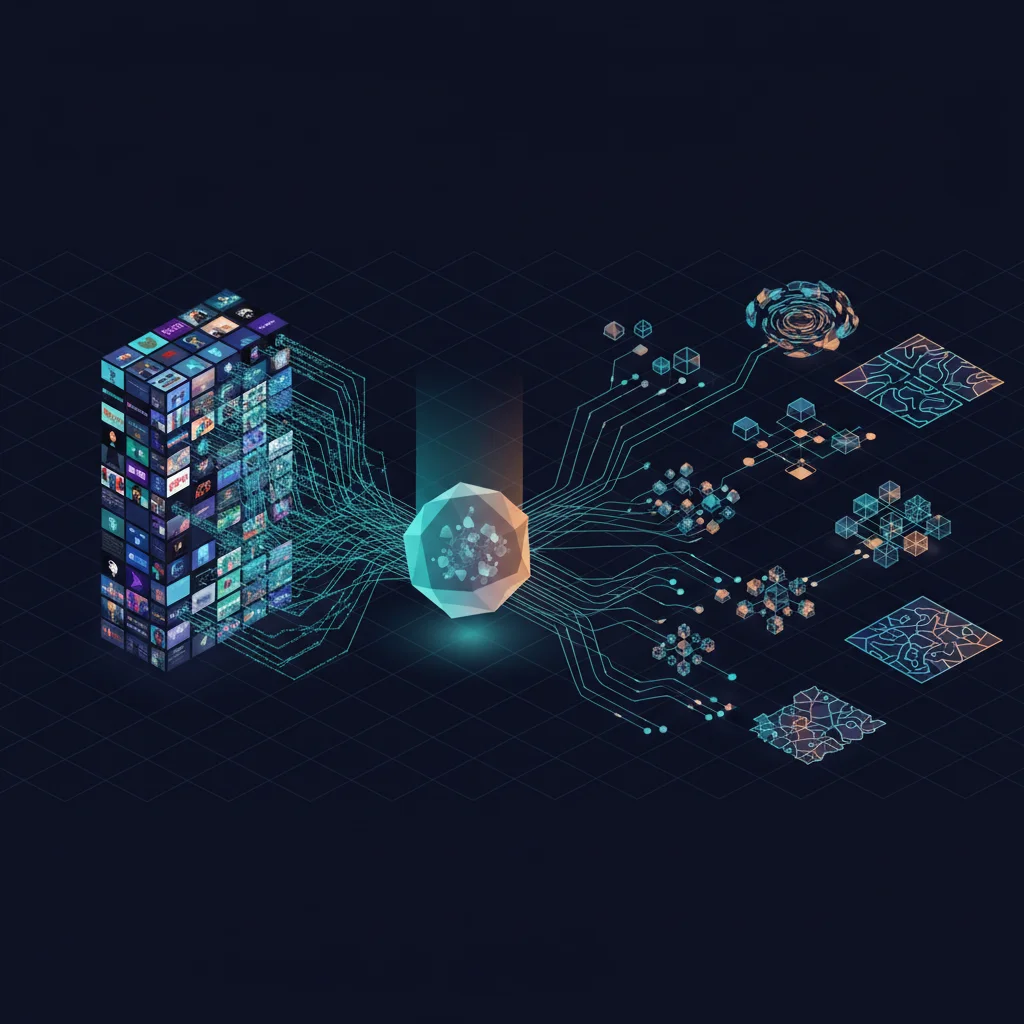
The workflow follows three steps: extract timestamped transcripts from videos, search across the corpus with natural language queries, and identify recurring patterns and themes. Each step builds on the previous one, moving from raw data to actionable insight.
Transcript Extraction
Pull the full text of every video. Taffy extracts timestamped transcripts from any public YouTube video with captions. One video takes seconds. A full channel of 200+ episodes takes minutes.
Output: Full transcript with timestamps, searchable text
Search Across Transcripts
Ask natural language questions across the entire corpus. Search for topics, names, concepts, or specific phrases. Find every time "product-market fit" was discussed across 200 episodes in one query.
Output: Relevant transcript segments, ranked by relevance
Pattern Extraction
Identify recurring themes, quantify topic frequency, and map how different experts discuss the same subject. Turn hundreds of hours of interviews into structured, comparative research.
Output: Topic frequency, expert comparisons, trend analysis
What Are the Most-Discussed Topics Across 200 Episodes?
Product-market fit dominates with 847 mentions, followed by growth loops (623), hiring (589), AI/ML (534), and retention (478). We extracted transcripts from over 200 episodes of Lenny's Podcast and analyzed every mention of key product and business topics, ranked by total mentions across all episodes.
What this tells us
Product-market fit dominates every other topic by a wide margin. It is not just the most discussed topic on Lenny's Podcast. It is the foundation that every other topic connects back to. Growth loops, retention, and pricing all assume you have PMF first. This pattern would be invisible from watching individual episodes but becomes obvious when you analyze transcripts at scale.
Search Across YouTube Transcripts
Taffy extracts and indexes transcripts from any YouTube channel. Search across hundreds of episodes, compare experts, and find topic patterns in minutes.
How Do You Compare Experts Across Different Channels?
Search for the same topic across multiple channels to see where experts agree, disagree, and what each emphasizes that others miss. Single-channel analysis shows you what one creator covers, but cross-channel analysis is where transcript research becomes genuinely powerful.
Take a topic like "sleep" and search across both Lenny's Podcast and the Huberman Lab. You get two completely different lenses on the same subject: one from a product and performance angle, the other from a neuroscience angle. The overlap reveals universal principles. The differences reveal domain-specific insight.
Lenny's Podcast on "Sleep"
Product & Performance Lens
- Sleep as a productivity lever for founders
- How sleep deprivation affects decision-making
- Building habits around sleep hygiene
- Work-life balance and rest as competitive advantage
Huberman Lab on "Sleep"
Neuroscience Lens
- Circadian rhythm mechanisms and light exposure
- Adenosine, cortisol, and melatonin cycles
- Temperature regulation for sleep onset
- Supplement protocols and clinical evidence
The Same Pattern Works for Any Topic
Search for "product-market fit" across business channels and you see how different experts define, measure, and achieve it. Search for "dopamine" across health channels and you see where neuroscience, psychology, and practical advice converge.
Product-Market Fit
Business channels
Sleep Optimization
Health channels
AI Strategy
Tech channels
Leadership
Management channels
Cross-channel analysis pairs well with our comment analysis workflow, which shows you what audiences think about the same topics these experts discuss. For choosing which channels to analyze in the first place, the hero channels framework provides a data-driven selection process.
Our take
Cross-channel transcript analysis is where this technique becomes genuinely irreplaceable. No amount of video watching lets you compare how five experts discuss the same topic side by side. When we searched 'sleep' across Huberman and Lenny's Podcast, we found that they barely overlap -- Huberman talks mechanisms and protocols, Lenny talks productivity impact and habits. Neither is wrong, but together they reveal that 'sleep' is actually two completely different conversations depending on your audience. That insight takes 30 seconds with transcripts and would take weeks of viewing to discover manually.
When Do Transcripts Beat Watching Videos?
Transcripts beat watching when you need to research across many videos, find specific quotes, detect patterns at scale, or compare expert perspectives side by side. They are not a replacement for watching videos, but a different tool for a different job. Knowing when to use each one is the key to efficient research.
Transcripts Win
- Research across many videos. Searching 200 transcripts takes seconds. Watching 200 videos takes months.
- Finding specific quotes. Ctrl+F through text beats scrubbing through video timelines.
- Pattern detection. Topic frequency, recurring themes, and expert consensus only emerge at scale.
- Comparison research. Putting expert perspectives side by side requires text, not video playback.
Watching Wins
- Visual demonstrations. Whiteboard explanations, product demos, and diagrams require video.
- Tone and delivery. Sarcasm, emphasis, and emotional nuance are lost in text.
- Initial discovery. When you do not yet know what to search for, browsing video is more effective.
- Deep single-video analysis. When one video is the focus, watching provides full context.
The best approach combines both. Use transcripts to identify the most relevant videos across a large set. Then watch the specific videos that matter most. Transcripts narrow the field. Video provides the depth.
How Do You Run Your Own Transcript Analysis?
Extract transcripts from target videos using Taffy, build your research corpus across a channel, search and extract patterns with natural language queries, and generate insights and reports. Everything in this guide was built using Taffy, and here is how you can run the same kind of analysis on any channel or topic.
Extract transcripts from target videos
Use Taffy's web interface, API, or MCP client to pull full transcripts with timestamps from any public YouTube video. One credit per transcript.
Build your research corpus
Process videos systematically across a channel. Start with the most popular episodes, then expand to the full library. The API makes batch processing straightforward.
Search and extract patterns
Use channel analysis features to ask natural language questions across all transcripts. Identify recurring topics, compare expert perspectives, and find specific quotes.
Generate insights and reports
Combine transcript search with comment analysis and video insights to build comprehensive research reports. The same data that produced this guide is available for any channel.
Turn Any YouTube Channel Into a Research Database
Taffy extracts transcripts, analyzes comments, and surfaces patterns across hundreds of videos. Stop watching. Start researching.
Frequently Asked Questions
Can Taffy extract transcripts from any YouTube video?
Yes. Taffy extracts full transcripts with timestamps from any public YouTube video that has captions enabled. This includes auto-generated captions and manually uploaded subtitles. Most YouTube videos have auto-generated captions available.
How accurate are YouTube auto-generated transcripts?
YouTube's auto-generated transcripts are typically 90-95% accurate for clear English speech. Quality varies with audio clarity, accents, and technical terminology. For research purposes, the accuracy is sufficient to identify topics, extract key themes, and find patterns across many videos.
How many videos can I analyze at once?
With Taffy, you can extract transcripts one video at a time through the API or web interface. For channel-level research, you can process videos systematically to build a searchable corpus of transcripts across hundreds of episodes.
What's the difference between transcript analysis and video summarization?
Video summarization gives you a condensed version of a single video. Transcript analysis lets you search across many videos, find patterns in what experts say over time, compare perspectives on the same topic, and extract recurring themes. It is research at scale vs. a single summary.
Can I search within transcripts for specific topics?
Yes. Taffy's transcript extraction gives you the full text, which you can then search. For channel-level research, Taffy's channel analysis features let you ask natural language questions across all of a channel's content.
Is transcript analysis useful for podcast research?
Absolutely. Many podcasts publish video versions on YouTube. Transcript analysis is especially powerful for interview-format podcasts where you want to extract what multiple guests say about the same topic across dozens of episodes.


Related Guides
YouTube Comment Analysis Guide
Turn 40,000 YouTube comments into a structured research report with sentiment analysis and theme extraction.
10 Skills for Thriving in the Age of AI
The skills that matter most as AI reshapes every industry and role.
Product Management Frameworks
31 frameworks, 12 rules, and 25 principles from 66 Lenny's Podcast episodes.
Written by
Arun Agrahri
Builder of Taffy. I spend most of my time analyzing YouTube channels to find patterns others miss. These guides are the result of processing thousands of videos and comments through our data pipeline.
Get the next guide first
We publish deep-dive research guides weekly. Be the first to know when new analysis drops.
No spam. Unsubscribe anytime.