NAD+ Precursors Ranked: NR vs NMN vs Niacin
NMN, NR, niacin -- the NAD+ supplement market has exploded, but the human evidence behind each precursor varies wildly. Dr. Rhonda Patrick has covered this topic extensively on FoundMyFitness, and her take across 99 videos is more nuanced than most influencers': which precursors actually have clinical data, which are overhyped, and whether any of them are worth the cost.
99
Videos analyzed
24,116
Comments analyzed
230
NAD+ questions from viewers
9
NAD+ supplement mentions
What Is NAD+ and Why Does It Decline?
Nicotinamide adenine dinucleotide (NAD+) is a coenzyme present in every living cell. It participates in over 500 enzymatic reactions and is essential for two fundamental processes: converting food into cellular energy (ATP) and activating sirtuins, the proteins that regulate DNA repair, inflammation, and cellular stress resistance.
The problem is straightforward: NAD+ levels decline with age. Research consistently shows a roughly 50% reduction between ages 40 and 60. This decline correlates with mitochondrial dysfunction, impaired DNA repair capacity, increased inflammation, and the onset of age-related diseases. As Dr. Rhonda Patrick has explained across multiple FoundMyFitness episodes, this decline is not merely a biomarker of aging but appears to be a causal driver of it.
NAD+ sits at the intersection of several aging pathways. It activates sirtuins (SIRT1-7), which regulate everything from mitochondrial biogenesis to epigenetic stability. It fuels PARP enzymes responsible for DNA repair. And it modulates CD38, an enzyme that actually consumes NAD+ and increases with age, creating a vicious cycle of declining levels.
Key insight from the research
Exercise naturally boosts NAD+ levels through AMPK activation and NAMPT upregulation. This is why Dr. Patrick and other longevity researchers emphasize that no supplement replaces vigorous exercise. The question is whether supplemental NAD+ precursors provide additional benefit on top of an active lifestyle.
Key Takeaway
NAD+ levels decline roughly 50% between ages 40 and 60. This decline is not merely a biomarker of aging -- it appears to be a causal driver, sitting at the intersection of mitochondrial function, DNA repair, and sirtuin activation. But exercise naturally boosts NAD+ through multiple pathways, which is why researchers emphasize it as the foundation before considering supplementation.
The body can synthesize NAD+ through multiple pathways, and each NAD+ precursor enters the cycle at a different point. Understanding these pathways is essential to evaluating which precursor, if any, makes sense for your situation.
The Three Precursors Explained
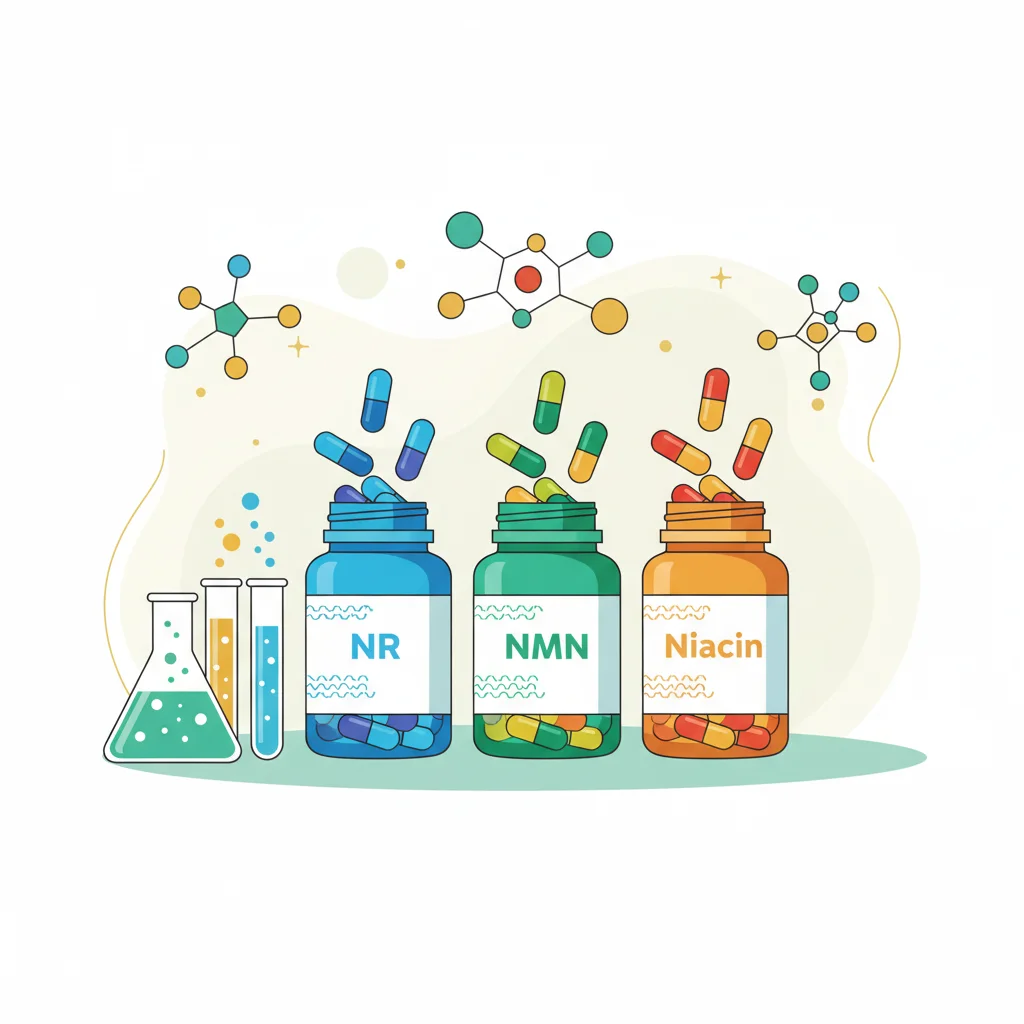
Three compounds dominate the NAD+ precursor market: nicotinamide riboside (NR), nicotinamide mononucleotide (NMN), and niacin (vitamin B3 in its various forms). Each enters the NAD+ biosynthesis pathway at a different step, and each has distinct advantages and limitations.
Nicotinamide Riboside
- Converted to NMN, then to NAD+
- Most published human clinical trials
- FDA GRAS designation (Niagen)
- Anti-inflammatory effects confirmed
Typical dose: 300-1000mg/day
Nicotinamide Mononucleotide
- One enzymatic step from NAD+
- Strong animal data (David Sinclair)
- FDA banned as supplement (Nov 2022)
- Growing human trial data
Typical dose: 250-1200mg/day
Niacin (Vitamin B3)
- Uses the Preiss-Handler pathway
- Decades of safety data
- Causes flushing at effective doses
- Niacinamide form inhibits sirtuins
Typical dose: 500-2000mg/day
NR (nicotinamide riboside) enters the salvage pathway and is phosphorylated by NR kinases (NRK1/NRK2) into NMN, which is then converted to NAD+ by NMNAT enzymes. This two-step process is well-characterized in humans. Dr. Patrick has noted that NR effectively boosts NAD+ levels and demonstrates anti-inflammatory benefits in published research. The compound holds FDA GRAS (Generally Recognized As Safe) status as Niagen, giving it a regulatory advantage.
NMN (nicotinamide mononucleotide) is one enzymatic step closer to NAD+ than NR, which has led to the popular argument that it should be more efficient. However, this reasoning oversimplifies the biology. NMN must be dephosphorylated to NR before entering cells via the SLC12A8 transporter, or converted through other pathways. The "one step closer" argument, which FoundMyFitness viewers frequently raise, does not account for absorption and cellular uptake kinetics. NMN gained widespread attention through David Sinclair's research in mice, but its regulatory status in the U.S. became complicated when the FDA ruled it could not be marketed as a dietary supplement in late 2022.
Niacin (nicotinic acid) is the original vitamin B3, known for decades. It enters NAD+ biosynthesis via the Preiss-Handler pathway and does raise NAD+ levels. The problem is side effects: nicotinic acid causes intense flushing (skin redness, warmth, itching) in most people at doses above 50mg. The "no-flush" alternative, niacinamide (nicotinamide), avoids flushing but inhibits sirtuins at higher doses, which partially undermines the purpose of boosting NAD+ for longevity.
| Feature | NR | NMN | Niacin |
|---|---|---|---|
| Steps to NAD+ | 2 | 1 | 3 |
| Pathway | Salvage (NRK) | Salvage (NMNAT) | Preiss-Handler |
| Human RCTs published | 15+ | 8+ | Extensive (lipids) |
| FDA status (U.S.) | GRAS / Supplement | Disputed | OTC supplement |
| Raises NAD+ in blood | Yes (confirmed) | Yes (confirmed) | Yes (confirmed) |
| Major side effects | Minimal | Minimal | Flushing (dose-dependent) |
| Sirtuin inhibition risk | No | No | Yes (niacinamide form) |
Human Clinical Trial Evidence
The gap between animal studies and human evidence is where most NAD+ supplement marketing falls apart. Mouse studies show dramatic results -- reversed aging biomarkers, improved mitochondrial function, extended lifespan. But humans are not mice, and the translation has been slower and more nuanced than early enthusiasts predicted.
NR: The strongest human dataset
NR has the most extensive human clinical trial portfolio among NAD+ precursors. Key findings from published randomized controlled trials include:
- NAD+ elevation: 1000mg/day of NR increased whole-blood NAD+ by approximately 60% in healthy middle-aged and older adults over 6 weeks (Martens et al., 2018).
- Anti-inflammatory effects: NR supplementation reduced circulating inflammatory cytokines, consistent with Dr. Patrick's observation that NR shows anti-inflammatory benefits.
- Cardiovascular signals: Trends toward reduced systolic blood pressure and aortic stiffness in older adults, though not all trials reached statistical significance.
- Exercise performance: No consistent improvement in exercise capacity in healthy, active individuals -- suggesting NR may be more beneficial for those with compromised NAD+ metabolism.
- Safety: Well-tolerated across all published trials at doses up to 2000mg/day, with adverse events comparable to placebo.
NMN: Promising but earlier-stage
NMN human trial data has expanded significantly since 2021, though the total body of evidence remains smaller than NR:
- NAD+ elevation: 250mg/day of NMN increased blood NAD+ metabolites in healthy adults (Yi et al., 2023).
- Insulin sensitivity: A Washington University study found NMN improved muscle insulin sensitivity in postmenopausal women with prediabetes (Yoshino et al., 2021).
- Aerobic capacity: A small trial in recreational runners showed improved aerobic endurance with 600-1200mg NMN daily.
- Sleep quality: Some trials report improvements in sleep quality metrics, particularly in older adults.
- Limitations: Most NMN trials have small sample sizes (under 50 participants) and short durations (8-12 weeks).
Niacin: Different evidence, different purpose
Niacin's human evidence base is enormous, but it was studied primarily for cardiovascular endpoints (lowering triglycerides, raising HDL cholesterol), not for NAD+-mediated longevity effects. The AIM-HIGH and HPS2-THRIVE trials dampened enthusiasm for niacin as a cardiovascular therapy, but its role as an NAD+ precursor has been re-evaluated separately. A Finnish study found niacin improved muscle NAD+ levels and mitochondrial function in adult-onset mitochondrial myopathy patients.
What the evidence actually shows
All three precursors raise NAD+ levels in humans. The critical unanswered question is whether raising NAD+ translates to measurable health outcomes in healthy people. Most trials showing functional benefits studied older adults or those with existing metabolic conditions. If you are young and healthy, the benefit may be marginal.
Explore the Full FoundMyFitness Analysis
Search transcripts, viewer questions, and expert positions across 99 videos covering NAD+ science, supplements, and longevity research.
Cost Analysis: Price Per Effective Dose
Cost is the factor that FoundMyFitness viewers raise most frequently after efficacy. As one commenter put it: "Am I investing in my longevity, or am I just throwing money in the trash by taking NMN?" The price difference between precursors is significant enough to change the practical recommendation.
| Metric | NR (Niagen) | NMN | Niacin |
|---|---|---|---|
| Clinical dose | 300-1000mg | 250-1200mg | 500-2000mg |
| Cost per day (low dose) | $0.80-1.30 | $0.60-1.50 | $0.03-0.10 |
| Cost per day (high dose) | $1.50-2.50 | $2.00-4.00 | $0.05-0.15 |
| Annual cost (mid dose) | $400-700 | $500-1,200 | $15-40 |
| Quality assurance | Patented (ChromaDex) | Varies by brand | Widely standardized |
| Price trend | Stable | Declining rapidly | Stable (already cheap) |
The cost gap is striking. Niacin costs roughly 1/30th of NR and 1/50th of NMN per day. For someone on a tight budget, niacin delivers genuine NAD+ elevation at a fraction of the price. The trade-off is the flushing side effect and the sirtuin inhibition concern with the niacinamide form.
Another viewer concern highlighted in the comments: "If most clinical studies used 1,000 mg daily of NR, why does TruNiagen contain only 300mg?" The answer involves both economics and science. 300mg of NR has been shown to meaningfully elevate NAD+ in published studies, though the magnitude is dose-dependent. Higher doses produce greater NAD+ elevation but at proportionally higher cost. The practical question is whether the additional NAD+ from higher doses translates to proportionally better outcomes -- and that question remains unanswered.
Budget-conscious approach
If cost is a concern, consider prioritizing omega-3s ($0.30-0.50/day), vitamin D ($0.05/day), and magnesium ($0.15-0.30/day) before adding any NAD+ precursor. These have stronger evidence and much lower cost. Dr. Patrick has consistently emphasized these foundational supplements as higher priority than NAD+ boosters. For a complete breakdown of how to build an affordable stack, see our budget longevity guide.
Safety and Cancer Risk
The most common safety concern among FoundMyFitness viewers is the relationship between NAD+ supplementation and cancer. This is not a fringe concern -- it reflects a genuine area of active research. One commenter asked directly: "Do NAD precursors increase cancer risk?" Another noted: "So cancer patients should shy away from supplementation because it may promote cancer growth?"
Important safety consideration
NAD+ is required for rapid cell division. Cancer cells are rapidly dividing cells. While NAD+ also supports DNA repair pathways that prevent cancer initiation, there is theoretical concern that supplementing NAD+ could fuel existing tumors. This concern is based on preclinical data and has not been conclusively demonstrated or refuted in human studies.
The dual nature of NAD+ in cancer biology
NAD+ plays opposing roles in cancer. On the protective side, NAD+ fuels PARP enzymes that repair DNA damage before it leads to malignant transformation. It activates SIRT1 and SIRT6, which suppress tumor formation through epigenetic regulation. Adequate NAD+ supports healthy immune surveillance that identifies and destroys precancerous cells. For the role NAD+ plays in brain health and neurodegeneration, the protective arguments are particularly compelling.
On the risk side, cancer cells are metabolically active and require NAD+ for their own survival and proliferation. Some research suggests that NAMPT (the rate-limiting enzyme in NAD+ salvage) is overexpressed in certain tumors. Preclinical studies have shown that inhibiting NAD+ synthesis can slow tumor growth in some cancer models.
Current medical guidance
No human clinical trial has demonstrated that NAD+ precursors increase cancer incidence. However, individuals with active cancer, a history of cancer, or elevated cancer risk factors should consult their oncologist before taking any NAD+ precursor. This is not a theoretical exercise -- it is standard clinical prudence when dealing with compounds that affect cell proliferation pathways.
Other safety considerations
- Liver enzymes: High-dose niacin (above 2g/day) has been associated with liver toxicity in some cases. NR and NMN have not shown this effect at studied doses.
- GI discomfort: Some users report mild nausea or diarrhea, particularly with NMN. This typically resolves within the first week.
- Drug interactions: NAD+ precursors may interact with chemotherapy agents, immunosuppressants, and blood thinners. Consult a physician if you take prescription medications.
- Pregnancy and breastfeeding: Insufficient data exists for NR or NMN during pregnancy. Niacin at standard dietary doses is safe, but therapeutic doses are not recommended.
Stacking with Other Supplements
A common question from FoundMyFitness viewers: "Does NR also need to be taken with TMG, CD38 inhibitor and NMNT inhibitor?" The supplement stacking question reflects a real biological concern. When NAD+ precursors are metabolized, they can deplete methyl donors, and certain enzymes can degrade the precursors before they reach cells.
Methyl donor support (TMG / betaine)
When NR or NMN is converted to NAD+, a byproduct (nicotinamide) is methylated for excretion. This consumes methyl groups from the body's SAM (S-adenosylmethionine) pool. High-dose NAD+ precursor supplementation without adequate methyl donor intake could theoretically deplete homocysteine recycling capacity. Trimethylglycine (TMG, also called betaine) at 500-1000mg is commonly recommended alongside NR or NMN to offset this effect.
Synergistic compounds discussed on FoundMyFitness
Resveratrol
Activates SIRT1 and may work synergistically with NAD+ to amplify sirtuin activity. One viewer asked: "Does drinking resveratrol and taking NAD+ supplements during fasting boost autophagy?" The mechanism is plausible but human evidence for the combination is limited.
Quercetin / Fisetin
These flavonoids inhibit CD38, the enzyme that degrades NAD+. By reducing NAD+ consumption, they may amplify the effect of precursor supplementation. Early data is encouraging but mostly preclinical.
Omega-3 fatty acids
Mentioned 18 times across the FoundMyFitness channel. Not directly related to NAD+ metabolism, but Dr. Patrick considers omega-3s a higher-priority foundational supplement that addresses inflammation through a separate pathway.
Sulforaphane
Mentioned 7 times on the channel. Activates Nrf2 detoxification pathways and may complement NAD+ supplementation by addressing oxidative stress through a distinct mechanism. Broccoli sprouts are the primary source.
Practical stacking priority
Dr. Patrick's body of work suggests a clear priority order: foundational nutrients first (omega-3s, vitamin D, magnesium), then well-evidenced performance compounds (creatine, sulforaphane), and finally experimental longevity molecules (NAD+ precursors). Adding an NAD+ precursor before addressing foundational deficiencies is like installing a turbocharger on a car with flat tires.
Our take
NAD+ precursors are the most over-marketed and under-evidenced category in the longevity supplement space. Animal studies look dramatic. Human studies show NAD+ levels go up, but the downstream health outcomes remain unclear for healthy people. Our honest assessment: if you are under 40, exercise regularly, and have no metabolic issues, you are unlikely to notice a meaningful difference. If you are over 50, have compromised mitochondrial function, or are dealing with metabolic decline, the case gets stronger. Either way, exercise boosts NAD+ naturally and has 100x more evidence behind it.
The Verdict: Who Should Take What
Best for: Evidence-first supplementers over 40
NR has the strongest human evidence base, FDA GRAS status, and confirmed anti-inflammatory effects. If you want the precursor with the most published safety and efficacy data, NR is the current leader. Start at 300mg/day and consider increasing to 1000mg if budget allows. Pair with TMG (500mg) to support methylation.
Best for: Those comfortable with emerging evidence
NMN has compelling animal data and growing human evidence, particularly for insulin sensitivity and aerobic performance. The regulatory uncertainty in the U.S. is a practical barrier, and purity varies between brands. If you go this route, choose a third-party tested product and start at 250-500mg/day.
Best for: Budget-conscious NAD+ optimization
Niacin is 30-50x cheaper than NR or NMN and does raise NAD+. If you can tolerate the flushing (which often diminishes over weeks), nicotinic acid at 500mg-1g is a legitimate low-cost option. Avoid high-dose niacinamide if sirtuin activation is your goal. This is the rational choice for those who cannot justify $400-1200/year on NAD+ precursors.
Best for most people: Skip NAD+ precursors (for now)
If you are under 40, exercise regularly, eat well, and have not addressed foundational supplements (omega-3s, vitamin D, magnesium, creatine), NAD+ precursors should not be your priority. Exercise itself raises NAD+ levels through AMPK activation. Put the $400-1200/year toward better food, a gym membership, or foundational supplements with stronger evidence.
Frequently Asked Questions
What is NAD+ and why does it matter for aging?
NAD+ (nicotinamide adenine dinucleotide) is a coenzyme found in every cell that is essential for energy metabolism, DNA repair, and sirtuin activation. NAD+ levels decline by roughly 50% between ages 40 and 60. This decline is associated with mitochondrial dysfunction, impaired DNA repair, and accelerated aging. Dr. Rhonda Patrick has discussed NAD+ precursors across multiple episodes, noting that NR effectively boosts NAD+ levels and shows anti-inflammatory benefits in human studies.
NR vs NMN: which NAD+ precursor is better?
NR has more published human clinical trial data, including studies showing effective NAD+ elevation and anti-inflammatory effects. NMN has strong animal data and growing human evidence, but fewer completed large-scale trials. Both raise NAD+ levels, but NR currently has the stronger evidence base in humans. As one FoundMyFitness viewer asked: "NMN vs. NR - does being one step closer really matter?" The conversion pathway matters less than the clinical outcomes.
Is niacin (vitamin B3) as effective as NR or NMN for boosting NAD+?
Niacin does raise NAD+ levels and costs roughly 1/30th the price of NR. However, nicotinic acid causes flushing at effective doses, and the niacinamide form inhibits sirtuins at high doses. NR and NMN avoid both problems, which is why researchers like Dr. Patrick focus on the newer precursors despite their higher cost.
Do NAD+ precursors increase cancer risk?
NAD+ supports rapid cell division, and cancer cells are rapidly dividing cells. However, NAD+ also supports DNA repair mechanisms that prevent cancer initiation. No human clinical trial has demonstrated increased cancer incidence from NAD+ precursors. People with active cancer or high cancer risk should consult their oncologist before supplementing.
How much NR or NMN should I take daily?
Most human clinical trials used 250-1000mg daily of NR (with 300mg and 1000mg being the most common). For NMN, trial dosing has ranged from 250mg to 1200mg daily. 300mg of NR has been shown to meaningfully elevate NAD+, while higher doses provide greater elevation at proportionally higher cost. Start with the lower dose and assess before increasing.
Are NAD+ precursors worth the cost for healthy people?
It depends on age, health status, and budget. NR costs $1-2/day, NMN $1.50-4/day. Exercise naturally boosts NAD+, and foundational supplements (omega-3s, vitamin D, magnesium) should be prioritized first. For people over 40 who have optimized basics, NAD+ precursors may offer meaningful benefits. For younger, healthy individuals, the cost-benefit is less clear.
Research Any Supplement Topic Yourself
Taffy lets you search transcripts, analyze comments, and extract insights from any YouTube channel. Ask questions like "What does Dr. Rhonda Patrick say about NMN?" and get answers from actual videos.
Want to see the full FoundMyFitness analysis?
Explore all 10 insight categories: themes, sentiment, viewer questions, superfans, content gaps, and more.
Explore @foundmyfitness Analysis
Written by
Arun Agrahri
Builder of Taffy. I spend most of my time analyzing YouTube channels to find patterns others miss. These guides are the result of processing thousands of videos and comments through our data pipeline.
Get the next guide first
We publish deep-dive research guides weekly. Be the first to know when new analysis drops.
No spam. Unsubscribe anytime.